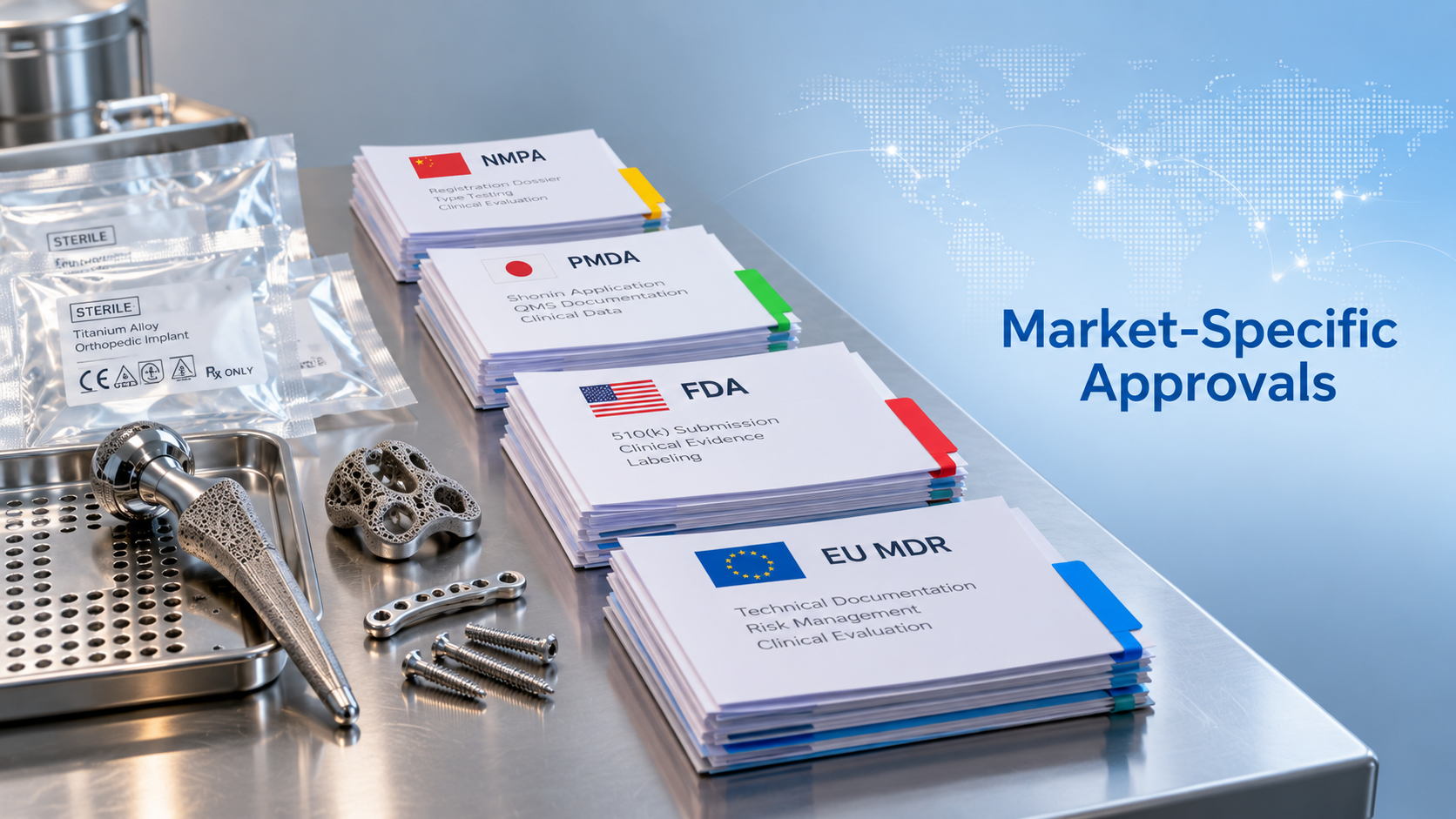
Medical Device Regulations: Costly Mistakes
For manufacturers of implants and high-value medical consumables, medical device regulations now determine market access, evidence costs, pricing power, and investor confidence.
A missed Class III requirement, weak ISO 10993 rationale, or incomplete CE MDR clinical evaluation can delay launches and destroy margins.
For enterprise decision-makers, the real question is not whether compliance matters, but which mistakes create avoidable commercial damage.
Why Regulatory Mistakes Become Business Failures
Medical device regulations are often treated as technical obligations, but their financial impact appears in launch timing, valuation, reimbursement, and channel access.
For orthopedic implants, cardiovascular devices, surgical staplers, catheters, and advanced dressings, compliance quality directly affects commercial credibility in demanding markets.
The costliest mistake is building regulatory strategy after product development, instead of designing evidence, materials, manufacturing, and claims together from the beginning.
Executives should view regulation as a market-entry architecture, not a final inspection performed after engineering teams have already locked decisions.
When compliance is late, teams often pay twice: once for redesign and again for delayed sales, duplicated testing, or additional clinical evidence.
In high-value consumables, even a six-month delay can weaken tender positioning, investor confidence, distributor commitment, and hospital adoption momentum.
Mistake One: Underestimating Device Classification
Classification is not a formality. It determines submission depth, clinical evidence expectations, quality system scrutiny, and post-market surveillance obligations.
Many companies underestimate risk classification when they compare their product to older devices approved under less demanding historical frameworks.
This mistake is especially dangerous for Class III implants, drug-device combinations, absorbable materials, and devices contacting blood or central circulation.
A spinal implant with porous titanium, a drug-eluting stent, or a neurovascular catheter may trigger evidence requirements far beyond basic performance testing.
Decision-makers should require an early classification memo that links intended use, contact duration, invasiveness, materials, claims, and target jurisdictions.
The memo should also identify where the United States, European Union, China, and other priority markets may classify the same product differently.
If classification is uncertain, the company should invest in pre-submission dialogue or expert review before freezing the development and launch budget.
Mistake Two: Treating ISO 10993 as a Testing Checklist
Biological safety is one of the most frequent sources of costly delay in medical device regulations, especially for implants and long-contact consumables.
Too many teams treat ISO 10993 as a laboratory checklist, ordering cytotoxicity, sensitization, and irritation tests without a coherent toxicological rationale.
Regulators increasingly expect a risk-based biological evaluation plan that connects materials, manufacturing residues, sterilization, degradation, and patient exposure.
For high-end implants, polymer catheters, tissue regeneration materials, and wound dressings, extractables and leachables can become decisive review questions.
A passed test result may not be enough if the sample does not represent final manufacturing, packaging, sterilization, or shelf-life conditions.
Executives should ask whether biological evaluation is integrated with supplier qualification, process validation, packaging design, and change control.
The practical goal is not simply passing ISO 10993 tests, but preventing later questions that force repeated testing and submission delays.
Mistake Three: Weak Clinical Evidence for High-Risk Devices
Clinical evidence has become a board-level issue under CE MDR and other strict regimes governing high-risk medical devices.
For Class III implants and cardiovascular interventional products, regulators expect more than literature summaries and similarity arguments.
Companies often overestimate equivalence to predicate or legacy devices while underestimating differences in materials, coating, geometry, delivery system, or indications.
This creates a painful gap between the evidence the business assumes is sufficient and the evidence reviewers actually require.
A weak Clinical Evaluation Report can trigger rounds of questions, postponed certification, additional post-market clinical follow-up, or even market withdrawal.
Decision-makers should demand an evidence map before major investment, showing existing data, missing endpoints, comparator logic, and clinical risk exposure.
For implants and cardiovascular devices, the evidence strategy should include survival rates, complication profiles, usability, real-world performance, and patient-relevant outcomes.
The best companies design clinical evidence to support both approval and commercial differentiation, not merely to satisfy minimum regulatory thresholds.
Mistake Four: Ignoring Manufacturing and Process Validation
A product can be scientifically promising and still fail regulatory review if manufacturing control cannot consistently reproduce its claimed performance.
This is critical for micron-level machining, porous structures, hydrophilic coatings, titanium staples, drug coatings, and sterile barrier systems.
Regulators assess whether the company can control variation across materials, dimensions, surface treatment, cleanliness, sterilization, and packaging integrity.
Common mistakes include changing suppliers without impact assessment, using development samples for testing, or validating processes after commercial scaling begins.
For decision-makers, the key question is whether manufacturing readiness matches regulatory submission maturity and forecasted market demand.
A process that works for pilot batches may fail when volume-based procurement or distributor contracts require stable, large-scale supply.
Process validation should be planned with quality, regulatory, engineering, procurement, and finance teams, because failures create both compliance and capacity risks.
Mistake Five: Separating Regulatory Strategy from Pricing and VBP Pressure
Medical device regulations do not operate in isolation from pricing systems, reimbursement policies, and volume-based procurement pressure.
A company may win approval but still lose commercially if evidence does not justify premium pricing or tender selection.
This is especially relevant for orthopedic consumables, coronary stents, staplers, dressings, and catheters facing aggressive cost-control policies.
Executives should connect regulatory evidence with health economics, clinical value messaging, and manufacturing cost structure before launch.
If a product claims better osseointegration, faster healing, lower thrombosis risk, or fewer complications, evidence must support those economic arguments.
Otherwise, procurement buyers may treat the product as interchangeable, forcing price competition despite high development and compliance investment.
A resilient strategy asks whether regulatory data can also defend reimbursement, hospital adoption, distributor confidence, and premium market positioning.
Mistake Six: Poor Change Control After Approval
Approval is not the end of regulatory responsibility. It is the beginning of a controlled lifecycle under ongoing surveillance.
Many expensive mistakes happen after commercialization, when companies adjust materials, suppliers, sterilization parameters, packaging, software, or labeling without proper assessment.
Small changes can affect biocompatibility, mechanical performance, shelf life, usability, or clinical claims, creating new regulatory obligations.
For global manufacturers, change control becomes harder because each jurisdiction may define reportable changes differently.
A modification accepted as minor in one market may require notification, approval, or supplemental documentation in another market.
Decision-makers should ensure that product lifecycle governance includes regulatory impact assessment before commercial teams promise supply changes or cost reductions.
Strong change control protects launch continuity, reduces recall exposure, and prevents tender commitments from colliding with compliance restrictions.
Mistake Seven: Underinvesting in Post-Market Surveillance
Post-market surveillance is now a strategic intelligence function, not a complaint file maintained only for audit readiness.
Regulators expect companies to detect trends, analyze adverse events, update risk management, and confirm real-world clinical performance.
For implants and life-channel devices, surveillance data can reveal failure modes before they become reputational or legal crises.
For wound care and minimally invasive consumables, it can also strengthen claims around healing, usability, and complication reduction.
The mistake is treating post-market data as defensive documentation rather than a source of product improvement and commercial proof.
Executives should invest in systems that connect complaints, vigilance reports, literature updates, registry data, distributor feedback, and hospital usage insights.
This integrated view helps companies respond faster, support renewals, defend market access, and identify evidence gaps before regulators do.
How Decision-Makers Should Prioritize Regulatory Investment
Not every regulatory activity deserves the same budget or executive attention. The priority should follow business impact and failure probability.
For early-stage products, classification, intended use, biocompatibility planning, and evidence mapping deserve immediate attention.
For development-stage products, manufacturing validation, clinical strategy, usability, packaging, sterilization, and risk management become urgent priorities.
For near-launch products, labeling, submission completeness, market-specific requirements, distributor readiness, and post-market surveillance plans require disciplined review.
For marketed products, change control, complaint trending, vigilance, periodic safety updates, and evidence renewal become the core protection layer.
A practical executive dashboard should track regulatory milestones beside cash burn, gross margin, capacity readiness, and target market launch dates.
This prevents the leadership team from discovering compliance risks only after capital, tooling, sales contracts, and clinical relationships are already committed.
What a Strong Regulatory Strategy Looks Like
A strong strategy begins with a clear commercial objective, then translates that objective into regulatory pathways, evidence requirements, and operational controls.
It defines which markets matter first, which claims create value, and which evidence is needed to support those claims.
It also identifies technical red lines, such as material toxicity, mechanical fatigue, coating durability, sterilization compatibility, and device-user interaction.
For Class III products, the strategy should include clinical evaluation planning, post-market clinical follow-up, risk management, and notified body engagement.
For consumables under pricing pressure, it should connect regulatory proof with differentiated clinical or economic value.
The strongest companies create cross-functional ownership, where regulatory, quality, clinical, engineering, finance, and commercial leaders share the same risk picture.
This alignment reduces late surprises and helps leadership make better trade-offs between speed, evidence investment, and market ambition.
When External Intelligence Becomes Worth the Cost
External regulatory intelligence is most valuable when internal teams face unfamiliar markets, high-risk classifications, or complex evidence expectations.
It is also useful when a company must evaluate acquisition targets, licensing opportunities, supplier changes, or post-approval expansion plans.
For enterprise leaders, the return is not merely a better document, but a more accurate view of launch risk.
Specialized intelligence can reveal whether a product is under-evidenced, overclaimed, poorly classified, or commercially vulnerable under procurement pressure.
In high-value medical consumables, this insight can prevent capital from flowing into products that look attractive but face hidden approval barriers.
It can also help premium technologies defend value where tenders and reimbursement systems increasingly compress margins.
The right advisory support should integrate toxicology, clinical science, regulatory pathways, manufacturing controls, and health-economic positioning.
Conclusion: Compliance Is a Profit Protection System
The most costly medical device regulations mistakes are rarely simple paperwork errors. They are strategic misjudgments made too late.
Underestimating classification, simplifying ISO 10993, weakening clinical evidence, ignoring validation, and separating compliance from pricing can damage enterprise value.
For decision-makers, the practical lesson is clear: regulatory strategy must be built into product, market, and investment planning from day one.
Companies that treat compliance as intelligence gain faster decisions, stronger evidence, safer products, and more defensible commercial positions.
In a market shaped by strict Class III scrutiny and procurement pressure, regulatory excellence is not a cost center.
It is a profit protection system, a launch accelerator, and a foundation for long-term trust in high-value medical technologies.
Get weekly intelligence in your inbox.
No noise. No sponsored content. Pure intelligence.
News Recommendations
 Oct 26, 2026Can a single approval cover life science product sales worldwide?Can a single approval cover life science product sales worldwide?
 Oct 25, 2026When is sensitization testing needed for medical device biocompatibility?When is sensitization testing needed for medical device biocompatibility?
 Oct 24, 2026How is biocompatibility tested for implantable polymer biomaterials?How is biocompatibility tested for implantable polymer biomaterials?
 Oct 23, 2026How to build reimbursement into an implant commercialization strategyHow to build reimbursement into an implant commercialization strategy
 Oct 22, 2026What clinical evidence do implants need for CE marking under EU MDR?What clinical evidence do implants need for CE marking under EU MDR?
 Oct 21, 2026How to choose disposable laparoscopic stapler reloads for thick tissueHow to choose disposable laparoscopic stapler reloads for thick tissue
 Oct 20, 2026How to assess medical polymer biocompatibility under ISO 10993How to assess medical polymer biocompatibility under ISO 10993
 Oct 19, 2026How do interventional device categories differ in clinical use?How do interventional device categories differ in clinical use?
 Oct 18, 2026When to choose alginate dressings for heavily exuding chronic woundsWhen to choose alginate dressings for heavily exuding chronic wounds
 Oct 17, 2026How is biocompatibility tested for custom medical-grade PEEK implants?How is biocompatibility tested for custom medical-grade PEEK implants?
 Oct 16, 2026How to check a wound healing materials supplier’s biocompatibility dataHow to check a wound healing materials supplier’s biocompatibility data
 Oct 15, 2026How to verify the FDA clearance status of silver wound dressingsHow to verify the FDA clearance status of silver wound dressings
 Oct 14, 2026How to register orthopedic implants and instruments in Latin AmericaHow to register orthopedic implants and instruments in Latin America
 Oct 13, 2026How to use a device market intelligence database to benchmark VBP pricesHow to use a device market intelligence database to benchmark VBP prices
 Oct 12, 2026When should stainless steel orthopedic instruments be replaced?When should stainless steel orthopedic instruments be replaced?
 Oct 11, 2026When are alginate dressings rope the right choice for cavity wounds?When are alginate dressings rope the right choice for cavity wounds?
 Oct 10, 2026When smart minimally invasive technology improves catheter accessWhen smart minimally invasive technology improves catheter access
 Oct 08, 2026Clinical evaluation requirements for cardiovascular implant devices in EuropeClinical evaluation requirements for cardiovascular implant devices in Europe
 Oct 07, 2026What to verify before appointing an artificial joint implants distributorWhat to verify before appointing an artificial joint implants distributor
 Oct 06, 2026How ISO 10993 guides biocompatibility testing for medical materialsHow ISO 10993 guides biocompatibility testing for medical materials
 Oct 05, 2026How to verify an orthopedic implants and instruments exporterHow to verify an orthopedic implants and instruments exporter
 Oct 04, 2026What drives surgical stapling devices price differences in hospital tenders?What drives surgical stapling devices price differences in hospital tenders?
 Oct 03, 2026How to assess a central venous catheter manufacturer's infection-control evidenceHow to assess a central venous catheter manufacturer's infection-control evidence
 Oct 02, 2026How to assess an advanced wound care factory’s quality systemHow to assess an advanced wound care factory’s quality system
 Oct 01, 2026What is driving global medical consumables demand in emerging markets?What is driving global medical consumables demand in emerging markets?
 Sep 30, 2026Implant Material Compliance Testing: Evidence Needed for Regulatory SubmissionImplant Material Compliance Testing: Evidence Needed for Regulatory Submission
 Sep 30, 2026From Corrosion to Fatigue: What Implant Materials Testing Should MeasureFrom Corrosion to Fatigue: What Implant Materials Testing Should Measure