Biodegradable Implants: How to Assess Safety, Strength, and Resorption Rate
Biodegradable Implants: A Practical Framework for Better Evaluation
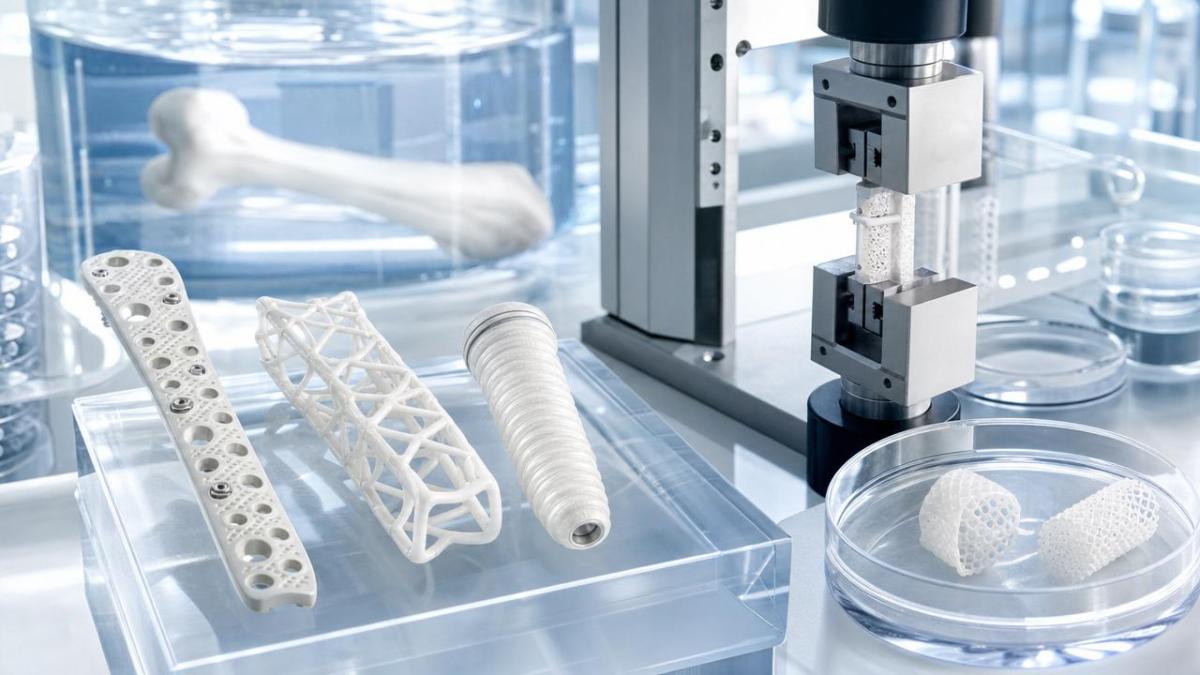
Biodegradable implants promise temporary support without leaving permanent hardware behind.
That idea is attractive, but evaluation cannot stop at the material label.
A strong selection process asks three linked questions.
Is the implant biologically safe, mechanically reliable, and predictably resorbed in vivo?
For technical decisions, these questions must be answered together, not in isolation.
A device can pass early strength tests and still fail because degradation shifts too fast.
It can also resorb cleanly, yet create local inflammation through byproducts or particulates.
This is why biodegradable implants demand system-level review.
From recent market movement, a clearer signal is emerging.
Buyers and developers now expect evidence that connects materials science with clinical performance and regulatory logic.
That also means evaluation teams need a sharper checklist than “biocompatible” or “absorbable.”
The better approach is to review biodegradable implants through intended use, loading profile, tissue environment, and degradation pathway.
Start with the Clinical Use Case, Not the Polymer Name
Not all biodegradable implants solve the same problem.
A craniofacial fixation plate, a vascular scaffold, and a soft tissue anchor face very different demands.
So the first screening step is application fit.
Define the anatomical site, healing window, load level, and failure consequences.
This sounds basic, but it prevents many poor comparisons.
For example, two biodegradable implants may share similar chemistry, yet one works only in low-load indications.
The other may need reinforced design or hybrid architecture.
In real procurement or development reviews, this is where teams should document decision boundaries.
- Expected support duration before tissue can carry load independently.
- Local environment, including blood contact, moisture, pH, enzymes, and infection risk.
- Need for imaging visibility, shape retention, or controlled radial force.
- Clinical tolerance for swelling, fragment release, or revision difficulty.
Once that context is clear, the rest of the assessment becomes more meaningful.
How to Assess Safety in Biodegradable Implants
Safety evaluation should begin with complete material characterization.
That includes base polymer, additives, residual monomers, catalysts, colorants, and processing residues.
For biodegradable implants, this is especially important because chemistry changes after implantation.
The body is not exposed only to the original device.
It is exposed to degradation intermediates, particles, and final metabolic products.
This is where ISO 10993 evidence must be interpreted carefully.
Cytotoxicity, sensitization, irritation, systemic toxicity, genotoxicity, and implantation studies all matter.
But test pass results alone are not enough.
The extraction conditions, sample aging, and test article state must reflect realistic use.
A fresh implant and a partially degraded implant can behave very differently.
A practical safety review for biodegradable implants should include the following points.
- Map every substance that may leach or form during degradation.
- Check whether byproducts accumulate locally faster than tissues can clear them.
- Review particulate generation under fatigue, cutting, crimping, or deployment.
- Confirm sterilization does not trigger chain scission or toxic residue concerns.
- Look for animal or clinical evidence of inflammation, fibrous encapsulation, or delayed healing.
One common mistake is treating published polymer safety as device safety.
Processing history, geometry, porosity, and sterilization can change the biological response.
So technical reviewers should always ask for finished-device evidence.
Mechanical Strength: Can the Implant Hold Long Enough?
For biodegradable implants, strength is never a one-time number.
The real question is whether strength remains adequate during the healing window.
That shifts testing from static values to time-based retention.
Initial tensile, compressive, bending, torsional, or radial properties still matter.
However, retained performance after hydration and incubation often matters more.
This is especially true for load-bearing or pulsatile applications.
Good evaluation should link bench testing to the real mechanical environment.
- Use simulated body conditions for temperature, fluid exposure, and loading frequency.
- Measure strength retention at multiple timepoints, not only at day zero.
- Include fatigue, creep, crack propagation, and notch sensitivity where relevant.
- Check deployment damage for stents, anchors, screws, and fixation systems.
Design details deserve the same attention as material selection.
Wall thickness, pore structure, fiber orientation, and molded weld lines can all change failure behavior.
More importantly, brittle failure is often less acceptable than gradual loss of support.
That means fracture mode should be reviewed, not just ultimate strength.
In selection work, compare biodegradable implants using a support-retention curve.
A single strength value can hide a rapid mid-term drop.
Resorption Rate: Predictability Matters More Than Speed
Fast resorption sounds attractive, but it is not automatically better.
The target is synchronized resorption.
The implant should lose mass and strength at a pace the tissue can match.
If degradation runs ahead of healing, mechanical failure risk rises.
If it runs too slowly, chronic foreign body response may continue longer than expected.
This is why biodegradation kinetics need close review.
For biodegradable implants, evaluators should ask for both mass-loss and molecular-weight data.
Mechanical retention should be plotted alongside those values.
That gives a clearer picture than any single endpoint.
In practice, variability matters almost as much as the mean value.
If biodegradable implants show wide batch-to-batch degradation spread, planning becomes harder.
That uncertainty can become a regulatory concern and a clinical risk.
Manufacturing Controls Often Decide Real-World Performance
Biodegradable implants are highly sensitive to processing conditions.
Melt temperature, humidity exposure, solvent removal, annealing, and sterilization can shift performance.
Even packaging can influence stability before use.
That is why supplier review should go beyond a datasheet.
Ask how the manufacturer controls molecular weight, crystallinity, moisture, and residuals.
Ask whether those attributes are trended lot by lot.
For technical evaluation, several process checkpoints are especially useful.
- Incoming raw material specifications and change control discipline.
- Validated drying, molding, extrusion, or printing windows.
- Residual solvent and residual monomer limits.
- Post-sterilization property verification and shelf-life data.
- Correlation between in-process metrics and final implant behavior.
This is often where stronger suppliers separate themselves from weaker ones.
Well-controlled manufacturing makes biodegradable implants more predictable, which directly supports better clinical confidence.
Regulatory Expectations and Decision Criteria
Regulators usually expect a joined-up story.
Material characterization, bench data, biological safety, animal evidence, and clinical rationale should align.
If the degradation profile is central to device performance, it must be well justified.
That includes worst-case assumptions.
For higher-risk devices, clinical evidence becomes hard to avoid.
Bench equivalence alone may not answer concerns around late inflammation, recoil, or loss of fixation.
A practical decision matrix for biodegradable implants should ask:
- Does the support period match the biological healing timeline?
- Are degradation products identified and clinically acceptable?
- Is retained strength adequate under realistic use conditions?
- Can process controls keep degradation behavior consistent across lots?
- Is the evidence package strong enough for the target market pathway?
If one answer remains weak, the overall risk picture stays weak too.
That is the practical reality of evaluating biodegradable implants today.
A Clearer Way to Compare Biodegradable Implants
The best decisions come from comparing trade-offs, not chasing ideal claims.
Some biodegradable implants offer better early strength.
Others offer cleaner resorption or simpler processing control.
The right choice depends on which risk matters most in the target indication.
A useful final screen is simple.
- Choose evidence over marketing language.
- Prioritize time-based performance over single-point testing.
- Connect degradation behavior with clinical function.
- Review manufacturing consistency as a core quality variable.
- Favor predictable outcomes over fast absorption claims.
When that framework is applied well, biodegradable implants become easier to assess and compare.
More importantly, selection decisions become easier to defend across R&D, quality, clinical, and regulatory review.
That is usually the difference between an interesting concept and a viable device strategy.
If the evidence shows safety, strength retention, and synchronized resorption together, biodegradable implants deserve serious consideration.
Get weekly intelligence in your inbox.
No noise. No sponsored content. Pure intelligence.
News Recommendations
 Sep 13, 2026What a medical device market insights platform reveals about market accessWhat a medical device market insights platform reveals about market access
 Sep 12, 2026When are collagen-based tissue healing materials suitable for wound care?When are collagen-based tissue healing materials suitable for wound care?
 Sep 11, 2026How catheter material selection affects total cost of ownershipHow catheter material selection affects total cost of ownership
 Sep 10, 2026What FDA clearance means for medical grade PEEK implantsWhat FDA clearance means for medical grade PEEK implants
 Sep 09, 2026When do hydrogel wound healing technologies suit dry wounds?When do hydrogel wound healing technologies suit dry wounds?
 Sep 07, 2026How to assess medical consumables for surgical useHow to assess medical consumables for surgical use
 Sep 07, 2026How to verify CE MDR compliance for single-use medical consumablesHow to verify CE MDR compliance for single-use medical consumables
 Sep 05, 2026How to evaluate an antithrombotic catheter factory for qualityHow to evaluate an antithrombotic catheter factory for quality
 Sep 04, 2026When do minimally invasive surgical staplers improve GI access?When do minimally invasive surgical staplers improve GI access?
 Sep 03, 2026When are foam moist wound healing dressings appropriate for exuding wounds?When are foam moist wound healing dressings appropriate for exuding wounds?
 Sep 02, 2026How implant pricing affects access to advanced medical careHow implant pricing affects access to advanced medical care
 Sep 01, 2026What is driving price pressure in the North American medical consumables market?What is driving price pressure in the North American medical consumables market?
 Aug 31, 2026Comparing medical devices in Southeast Asia when market access differsComparing medical devices in Southeast Asia when market access differs
 Aug 30, 2026When are 3D printed PEEK implants suitable for spinal reconstruction?When are 3D printed PEEK implants suitable for spinal reconstruction?
 Aug 29, 2026How global medical device regulations shape clinical evidence requirementsHow global medical device regulations shape clinical evidence requirements
 Aug 28, 2026How to verify a burn care dressings exporter meets EU MDR requirementsHow to verify a burn care dressings exporter meets EU MDR requirements
 Aug 27, 2026How to verify a diabetic foot wound care supplier’s clinical evidenceHow to verify a diabetic foot wound care supplier’s clinical evidence
 Aug 26, 2026What drives spinal implants price differences across implant typesWhat drives spinal implants price differences across implant types
 Aug 25, 2026What matters most in a medical consumables platform comparisonWhat matters most in a medical consumables platform comparison
 Aug 24, 2026What a medical device intelligence guide should cover before market accessWhat a medical device intelligence guide should cover before market access
 Aug 23, 2026What drives catheter coating technology cost in early device designWhat drives catheter coating technology cost in early device design
 Aug 22, 2026How custom 3D printed medical implants meet biocompatibility requirementsHow custom 3D printed medical implants meet biocompatibility requirements
 Aug 21, 2026What makes an implant commercialization strategy in Europe fail at market accessWhat makes an implant commercialization strategy in Europe fail at market access
 Aug 20, 2026What drives catheter coating technology cost in product developmentWhat drives catheter coating technology cost in product development
 Aug 19, 2026What drives medical device compliance cost during market entryWhat drives medical device compliance cost during market entry
 Aug 18, 2026When does an antimicrobial central venous catheter lower infection risk?When does an antimicrobial central venous catheter lower infection risk?
 Aug 17, 2026What ISO 13485 means for medical precision machining suppliersWhat ISO 13485 means for medical precision machining suppliers