Biodegradable Implants: Key Failure Risks and Biocompatibility Checks
Where biodegradable implants create value, risk starts changing
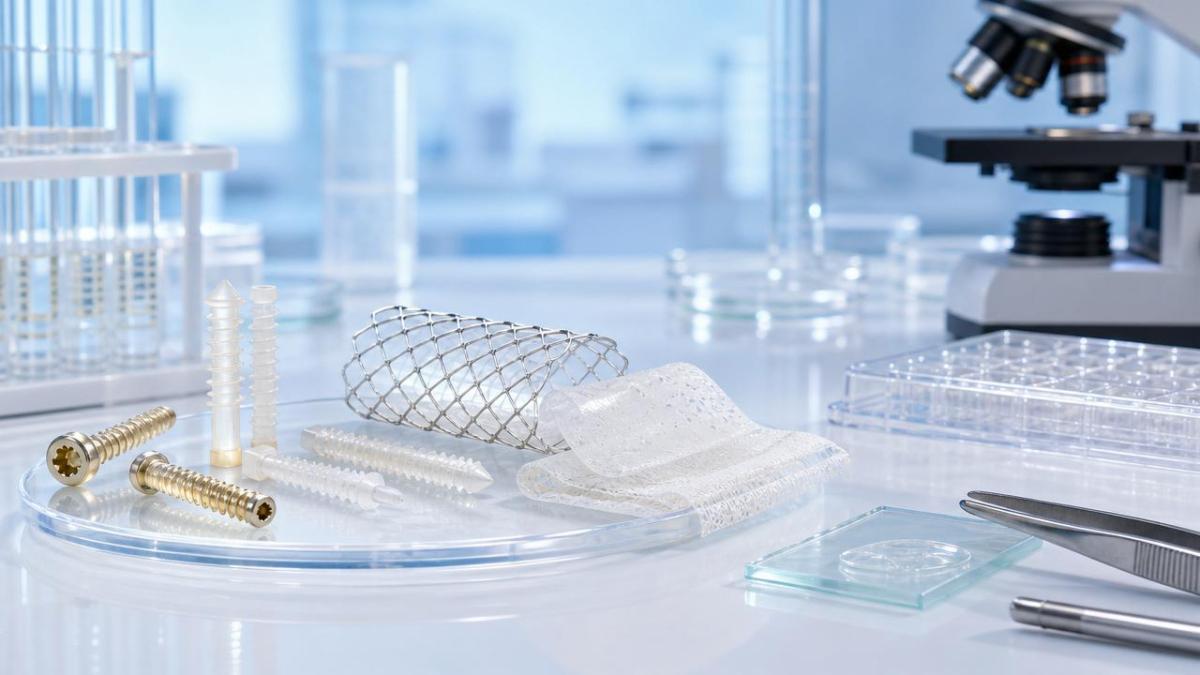
Biodegradable implants reduce removal surgeries and can support more natural tissue healing.
That promise matters across orthopedic fixation, cardiovascular repair, tissue regeneration, and selected minimally invasive procedures.
Yet the same feature that makes biodegradable implants attractive also makes them difficult to control.
A permanent implant is judged by long-term stability.
A degradable one must remain stable first, then disappear at the right pace.
In practice, failures rarely come from one parameter alone.
They usually emerge where material behavior, local biology, machining precision, and regulatory evidence do not align.
That is why biodegradable implants deserve the same cross-disciplinary attention seen in Class III implant intelligence platforms such as IMCS.
The key question is not whether degradation occurs.
The key question is whether degradation matches tissue recovery, load transfer, and clinical reality.
Actual use conditions change what “safe enough” means
Different scenarios place biodegradable implants under very different biological and mechanical pressures.
A fixation screw in cancellous bone behaves differently from a vascular scaffold in pulsatile blood flow.
A tissue regeneration matrix faces another challenge altogether.
The local environment can shift pH, fluid exposure, enzymatic attack, and inflammatory burden.
At the same time, precision processing affects surface roughness, porosity, residual stress, and particle release.
For biodegradable implants, small manufacturing differences can become large clinical differences.
A useful evaluation path usually combines three layers.
- First, define the real implantation environment and expected healing timeline.
- Then, compare degradation behavior with required mechanical retention.
- Finally, confirm biocompatibility evidence under both fresh and degraded states.
This sequencing prevents a common mistake.
Many teams test the starting material thoroughly, but under-test the breakdown products that patients actually encounter later.
In load-bearing repair, premature loss of strength is usually the first red flag
Orthopedic biodegradable implants often look promising because they may avoid hardware removal.
But bone healing is not uniform across sites, ages, or defect types.
In craniofacial fixation, load may be moderate and healing relatively predictable.
In weight-bearing applications, the tolerance for early strength loss is far lower.
This is where biodegradable implants can fail quietly.
Mechanical collapse may begin before imaging or symptoms clearly show the problem.
The practical checks should therefore go beyond initial tensile or compressive data.
- Track strength retention over the full healing window, not only at day zero.
- Evaluate fatigue under cyclic loading and wet conditions.
- Check whether degradation changes crack propagation behavior.
- Review debris formation around drilled, threaded, or porous features.
For IMCS-relevant orthopedic intelligence, this matters because porous structures, polymers, and hybrid materials are increasingly judged together.
A biodegradable implant should not be benchmarked only against another degradable device.
It should also be compared with the functional reliability expected from established implant systems.
In vascular and soft-tissue environments, biology often outruns bench assumptions
When biodegradable implants enter blood-contacting or soft-tissue settings, the judgment focus changes.
Here, inflammatory response, thrombogenicity, endothelial recovery, and local acidity may matter more than static strength alone.
A resorbable scaffold in a dynamic vessel faces flow shear, drug interaction, and uneven tissue coverage.
A regenerative membrane or plug may instead face fluid absorption and cell-mediated remodeling.
The failure pattern is often less visible than fracture.
It may appear as persistent inflammation, delayed endothelialization, thrombus tendency, or foreign-body reaction.
That is why biocompatibility checks for biodegradable implants should be staged, not treated as a single approval box.
In blood or soft tissue contact, ISO 10993 evidence needs interpretation in context.
Cytotoxicity, sensitization, irritation, systemic toxicity, hemocompatibility, and implantation studies should connect back to real degradation chemistry.
What usually deserves closer comparison across scenarios
This comparison helps separate true scenario fit from generic material optimism.
Biocompatibility checks matter most when they follow the degradation pathway
A frequent misjudgment is to treat biodegradable implants like inert devices with a shorter lifespan.
That misses the central safety issue.
The body interacts not only with the implant surface, but also with oligomers, ions, particles, additives, and processing residues released over time.
For that reason, high-value checks usually include both material-level and system-level evidence.
- Chemical characterization before and after simulated degradation.
- Extractables and leachables linked to sterilization and packaging.
- Local tissue reaction at multiple timepoints, not one endpoint.
- Particle burden and phagocytic response where abrasion is possible.
- Correlation between in vitro degradation and in vivo behavior.
The last item is often the hardest.
Bench media can oversimplify real tissue chemistry.
A biodegradable implant that looks stable in buffered solution may degrade differently in inflammatory or mechanically stressed tissue.
In a CE MDR or broader global submission context, weak correlation here can undermine the whole clinical argument.
Where teams often misread the scenario before launch
Some mistakes appear repeatedly across implant programs.
One is assuming similar anatomy means similar risk.
A small fixation device in one bone site may not translate to another with different vascularity or load transfer.
Another is focusing on headline degradation time while ignoring the shape of the degradation curve.
A six-month resorption profile can still be unsafe if mechanical support drops sharply in month one.
Cost pressure creates another blind spot.
Under VBP-style market conditions, there can be pressure to simplify testing or standardize one platform too broadly.
For biodegradable implants, that shortcut often increases downstream clinical and regulatory risk instead of reducing total program cost.
Processing is also underestimated.
Micron-level machining, molding heat history, coating adhesion, and sterilization exposure can all alter degradation behavior.
This is especially relevant when devices sit near the boundary between precision consumables and true implantable systems.
A more reliable way to match biodegradable implants to real programs
A practical assessment starts with the clinical window the implant must protect.
Map that window against mechanical retention, local biology, and degradation outputs.
Then verify whether the manufacturing route can reproduce that balance consistently.
For biodegradable implants, useful adaptation steps usually look like this.
- Define the exact tissue environment and contact duration.
- Set minimum strength retention milestones tied to healing stages.
- Build biocompatibility plans around degradation products, not only base resin or alloy.
- Compare sterilization, packaging, and shelf-life effects on degradation onset.
- Use clinical evidence to confirm that bench assumptions hold in practice.
This approach fits the broader IMCS view of implant intelligence.
Material science, biocompatibility, precision manufacturing, and reimbursement pressure cannot be assessed in isolation.
Biodegradable implants succeed when those layers are stitched together early.
Before moving forward, it helps to sort target scenarios, compare load and healing conditions, and document which failure mode would be unacceptable in each use case.
That makes the next step clearer: build a scenario-based verification plan, then test the implant as it will actually age inside the body.
Get weekly intelligence in your inbox.
No noise. No sponsored content. Pure intelligence.
News Recommendations
 Sep 13, 2026What a medical device market insights platform reveals about market accessWhat a medical device market insights platform reveals about market access
 Sep 12, 2026When are collagen-based tissue healing materials suitable for wound care?When are collagen-based tissue healing materials suitable for wound care?
 Sep 11, 2026How catheter material selection affects total cost of ownershipHow catheter material selection affects total cost of ownership
 Sep 10, 2026What FDA clearance means for medical grade PEEK implantsWhat FDA clearance means for medical grade PEEK implants
 Sep 09, 2026When do hydrogel wound healing technologies suit dry wounds?When do hydrogel wound healing technologies suit dry wounds?
 Sep 07, 2026How to assess medical consumables for surgical useHow to assess medical consumables for surgical use
 Sep 07, 2026How to verify CE MDR compliance for single-use medical consumablesHow to verify CE MDR compliance for single-use medical consumables
 Sep 05, 2026How to evaluate an antithrombotic catheter factory for qualityHow to evaluate an antithrombotic catheter factory for quality
 Sep 04, 2026When do minimally invasive surgical staplers improve GI access?When do minimally invasive surgical staplers improve GI access?
 Sep 03, 2026When are foam moist wound healing dressings appropriate for exuding wounds?When are foam moist wound healing dressings appropriate for exuding wounds?
 Sep 02, 2026How implant pricing affects access to advanced medical careHow implant pricing affects access to advanced medical care
 Sep 01, 2026What is driving price pressure in the North American medical consumables market?What is driving price pressure in the North American medical consumables market?
 Aug 31, 2026Comparing medical devices in Southeast Asia when market access differsComparing medical devices in Southeast Asia when market access differs
 Aug 30, 2026When are 3D printed PEEK implants suitable for spinal reconstruction?When are 3D printed PEEK implants suitable for spinal reconstruction?
 Aug 29, 2026How global medical device regulations shape clinical evidence requirementsHow global medical device regulations shape clinical evidence requirements
 Aug 28, 2026How to verify a burn care dressings exporter meets EU MDR requirementsHow to verify a burn care dressings exporter meets EU MDR requirements
 Aug 27, 2026How to verify a diabetic foot wound care supplier’s clinical evidenceHow to verify a diabetic foot wound care supplier’s clinical evidence
 Aug 26, 2026What drives spinal implants price differences across implant typesWhat drives spinal implants price differences across implant types
 Aug 25, 2026What matters most in a medical consumables platform comparisonWhat matters most in a medical consumables platform comparison
 Aug 24, 2026What a medical device intelligence guide should cover before market accessWhat a medical device intelligence guide should cover before market access
 Aug 23, 2026What drives catheter coating technology cost in early device designWhat drives catheter coating technology cost in early device design
 Aug 22, 2026How custom 3D printed medical implants meet biocompatibility requirementsHow custom 3D printed medical implants meet biocompatibility requirements
 Aug 21, 2026What makes an implant commercialization strategy in Europe fail at market accessWhat makes an implant commercialization strategy in Europe fail at market access
 Aug 20, 2026What drives catheter coating technology cost in product developmentWhat drives catheter coating technology cost in product development
 Aug 19, 2026What drives medical device compliance cost during market entryWhat drives medical device compliance cost during market entry
 Aug 18, 2026When does an antimicrobial central venous catheter lower infection risk?When does an antimicrobial central venous catheter lower infection risk?
 Aug 17, 2026What ISO 13485 means for medical precision machining suppliersWhat ISO 13485 means for medical precision machining suppliers