How to build reimbursement into an implant commercialization strategy
How to build reimbursement into an implant commercialization strategy
Regulatory authorization does not guarantee reimbursement—or commercial success. For implant manufacturers, an effective implant commercialization strategy must connect clinical evidence, payer coverage, coding, and payment with the economics of hospital adoption. Addressing these factors early helps decision-makers identify evidence gaps, prioritize viable markets, and strengthen pricing discussions before launch.
The practical problem often appears in a hospital value-analysis meeting. A surgeon supports the implant, the regulatory team has completed its work, and procurement has a quotation. Then finance asks: “Does our payment cover the additional cost, and what evidence justifies changing?” If the answer depends entirely on benefits expected years later, adoption may stall despite genuine clinical interest.
Start with the reimbursable care pathway, not the device
Before committing to a launch indication, define who receives the implant, where the procedure occurs, what treatment it replaces, and who pays. “Spinal implant” or “transcatheter valve” is not a sufficiently precise market-access definition. Patient eligibility, treatment setting, procedural approach, and payer mix can change the commercial opportunity substantially.
Separate three questions that commercial teams sometimes collapse into one:
- Coverage: Will the payer fund the procedure for the intended patient, and under what clinical conditions?
- Coding: How will the provider accurately describe the procedure, diagnosis, and device where applicable?
- Payment: What does the provider receive, and is the implant included in that amount or paid separately?
An existing code does not establish coverage. Coverage does not establish an adequate payment amount. Nor does the absence of a device-specific code automatically prevent reimbursement: an implant may be included within a broader procedural payment.
Build a pathway assessment for each priority indication and setting. Record the relevant policies, coding options, payment mechanism, restrictions, effective dates, and unresolved questions. Have qualified local reimbursement specialists validate it. This should be a maintained decision document, not a slide assembled just before distributor training.
Make hospital economics a design input
A payer may consider long-term revision risk, while a hospital must also manage the cost of the current admission. Both perspectives matter, but they support different purchasing arguments.
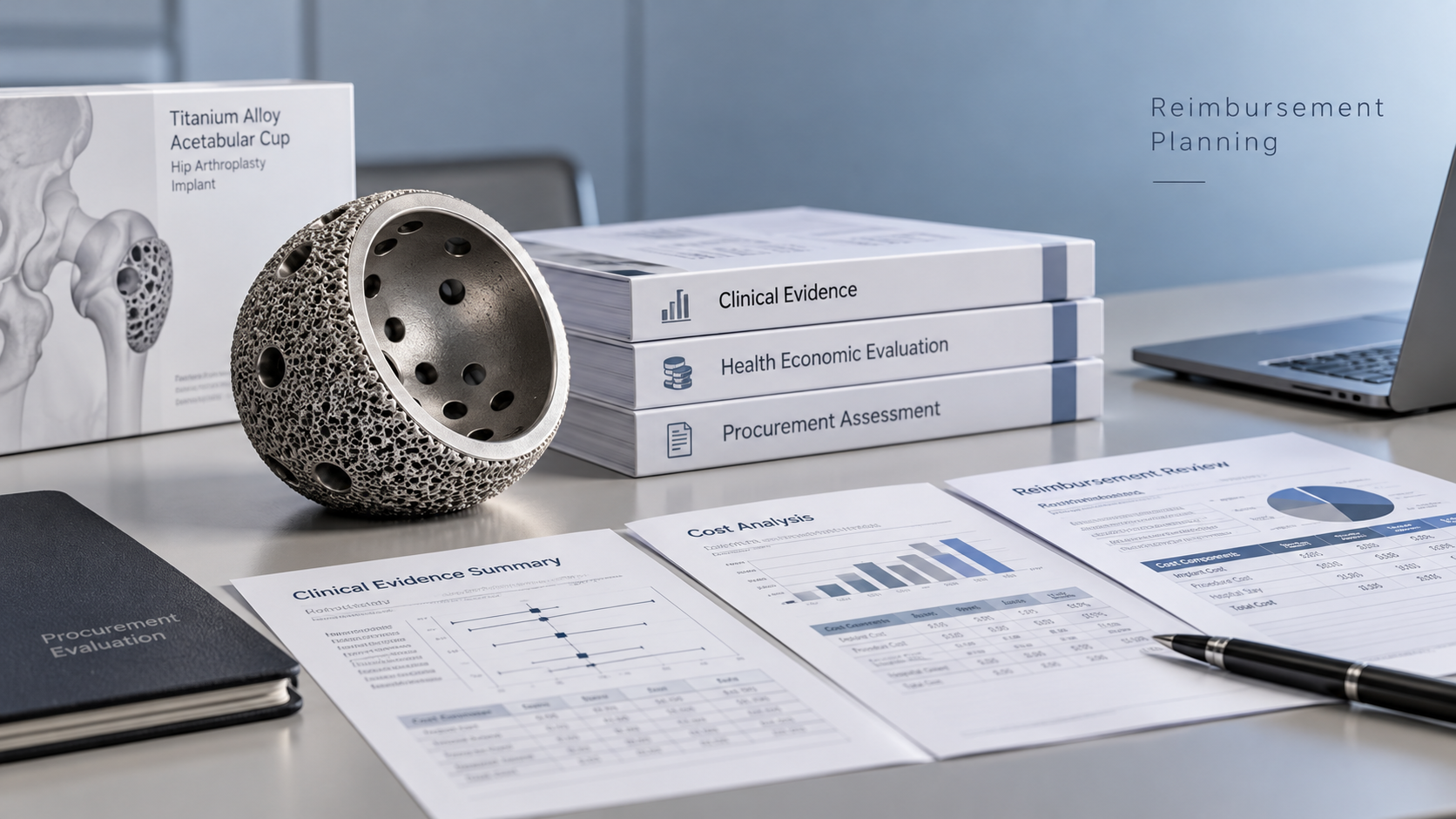
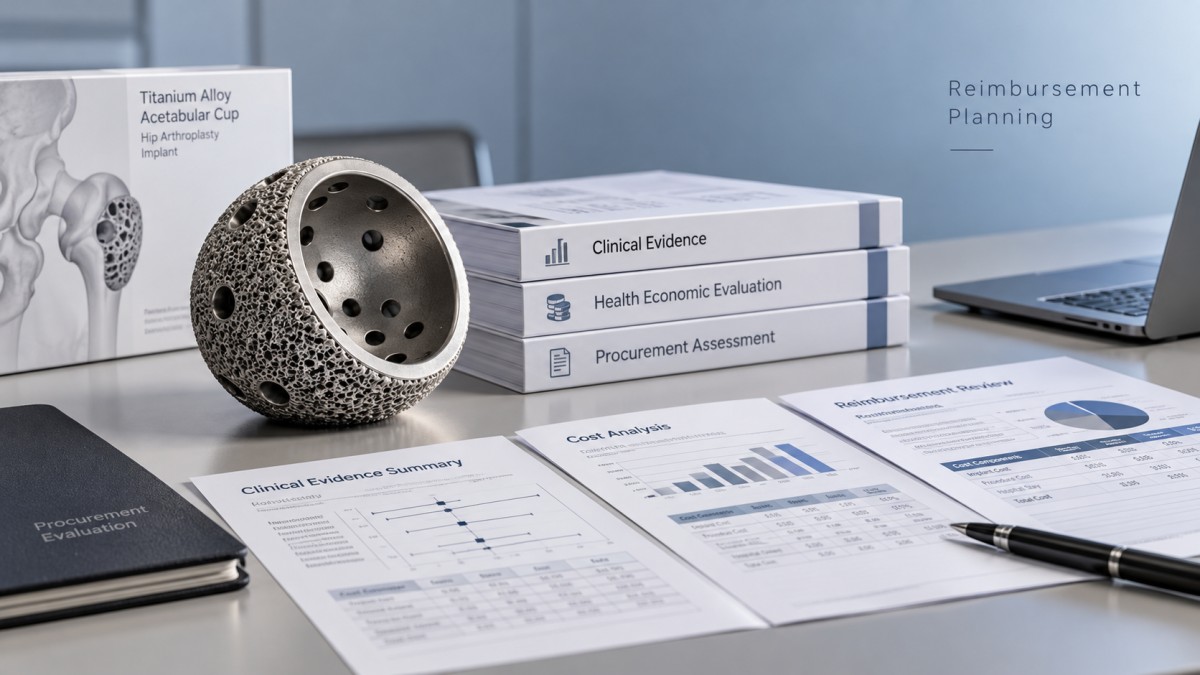
Consider a hypothetical porous orthopedic implant carrying a premium over an established alternative. Better fixation is a plausible clinical proposition, but a surface architecture alone does not demonstrate fewer revisions. If the hospital receives a bundled payment, the immediate premium may sit entirely within its existing budget. The manufacturer needs evidence supporting the claimed benefit, a credible near-term operational advantage, or a narrower initial population where the value proposition is stronger.
Model the provider’s episode economics using local inputs: expected payment, implant and accessory costs, operating-room resources, length of stay, instrument processing, and implementation costs. For orthopedic systems, include loaner trays and instrumentation support. For cardiovascular implants, account for delivery-system consumables and training requirements. A lower implant price can still produce an expensive procedure.
Keep hospital margin analysis separate from payer budget impact. Avoid claiming that a shorter operation automatically creates cash savings; released operating-room capacity only becomes financially valuable if the hospital can use it or reduce expenditure. Likewise, a potential reduction in future revisions should not be counted as a current hospital saving without examining who bears those future costs.
Test a conservative scenario before approving the launch price. If adoption depends on every projected efficiency materializing immediately, the commercial model is fragile.
Collect evidence that answers the funding objection
Reimbursement planning belongs upstream of clinical protocol finalization. Adding resource-use measures after a pivotal study ends is often more difficult than collecting them prospectively, especially when hospital records cannot reliably reconstruct the relevant detail.
The evidence plan should begin with the decision likely to block adoption. Does the payer question clinical benefit over the current standard? Does the hospital question procedural cost? Does an assessment body require comparative effectiveness data in a defined subgroup? Each objection calls for different evidence.
For permanent implants, durability creates a timing problem: purchasing decisions arrive before mature long-term outcomes. Address that uncertainty explicitly. Distinguish observed outcomes from modeled projections, explain the assumptions behind extrapolation, and test whether the value proposition survives less favorable durability estimates.
Biocompatibility testing and manufacturing validation remain essential, but they answer different questions. ISO 10993-related biological evaluation does not establish cost-effectiveness. Likewise, regulatory clinical evidence may need additional comparators, endpoints, or analyses to support payer decisions. The efficient approach is to coordinate evidence generation, not assume one dossier will satisfy every audience.
Choose markets by access feasibility, not approval timing alone
A global implant commercialization strategy needs country-level access plans. Regulatory recognition, reimbursement, hospital purchasing, and tender eligibility operate through different processes. An early authorization may create little near-term revenue if the funding route remains unresolved.
United States: distinguish the payer, setting, and payment system
For Medicare, inpatient hospital, outpatient hospital, ambulatory surgical center, and physician payments follow different rules. A procedure’s treatment in one setting should not be carried into another without verification. Commercial payer policies may also differ from Medicare.
Use current CMS coverage resources and applicable payment-system materials to verify assumptions. Where temporary additional payment pathways may be relevant, check the current eligibility criteria, application deadlines, and duration. Treat them as conditional opportunities—not permanent support for an otherwise unworkable price.
Europe: CE marking is not a funding decision
CE marking under the applicable medical device framework does not create uniform reimbursement across Europe. National assessment processes, regional budgets, hospital payment arrangements, and local procurement can all affect access. A favorable assessment also does not necessarily translate into immediate purchasing availability.
Select initial countries partly on the fit between available evidence and local decision requirements. Translating a U.S. economic model without changing the comparator, resource costs, clinical pathway, and budget perspective rarely produces a convincing submission.
China: assess procurement and reimbursement separately
For categories subject to volume-based procurement, tender pricing and supply commitments can materially reshape margins. Procurement participation, hospital access, and reimbursement are related but distinct questions. Verify the relevant product grouping, geographic scope, award terms, and current implementation rules rather than applying one category’s experience to another.
A premium implant also needs a defensible assessment of how it will be classified. Technical differentiation does not automatically place a product outside an existing procurement group. Model the possibility of price compression alongside manufacturing capacity, delivery obligations, and service costs before committing to the market.
Turn reimbursement readiness into an investment gate
Assign one accountable market-access lead, but make reimbursement a shared operating responsibility. Clinical teams own evidence execution; regulatory teams maintain alignment with the intended use; finance tests price and margin assumptions; commercial teams validate purchasing realities. Leaving the entire task to sales after authorization usually exposes gaps when they are most expensive to fix.
Use a small number of concrete release gates:
- Before protocol lock: confirm the priority population, comparator, payer objections, and economic data requirements.
- Before manufacturing scale-up: test achievable net prices against realistic access conditions and full service costs.
- Before launch: validate coding guidance, coverage restrictions, provider economics, and the process for handling access questions.
- During early adoption: review purchasing delays, reimbursement denials where relevant, realized prices, and evidence gaps—not just surgeon interest.
The launch support package should contain a balanced evidence summary, transparent economic model, locally reviewed billing information, and a clear escalation route. It should not promise reimbursement or suggest coding that misrepresents the procedure performed. Where lawful and appropriate, conditional purchasing arrangements may help manage uncertainty, but only if outcomes, data responsibilities, and financial terms are workable.
This is where the Global Implant & Medical Consumables Systems (IMCS) perspective is useful: connecting implant materials, clinical evidence, regulatory requirements, and procurement intelligence rather than examining them in isolation. A technically credible product can still face an unfavorable payment pathway; a funded procedure can still be commercially unattractive under tender pricing and demanding service obligations.
Before approving the next major investment, ask the team to show a traceable chain from intended patient to coverage, accurate coding, provider payment, hospital purchasing, and viable manufacturer margin. If one link rests on an assumption, assign an owner and a validation deadline. That is a more useful launch-readiness test than regulatory progress alone.
Get weekly intelligence in your inbox.
No noise. No sponsored content. Pure intelligence.
News Recommendations
 Oct 26, 2026Can a single approval cover life science product sales worldwide?Can a single approval cover life science product sales worldwide?
 Oct 25, 2026When is sensitization testing needed for medical device biocompatibility?When is sensitization testing needed for medical device biocompatibility?
 Oct 24, 2026How is biocompatibility tested for implantable polymer biomaterials?How is biocompatibility tested for implantable polymer biomaterials?
 Oct 23, 2026How to build reimbursement into an implant commercialization strategyHow to build reimbursement into an implant commercialization strategy
 Oct 22, 2026What clinical evidence do implants need for CE marking under EU MDR?What clinical evidence do implants need for CE marking under EU MDR?
 Oct 21, 2026How to choose disposable laparoscopic stapler reloads for thick tissueHow to choose disposable laparoscopic stapler reloads for thick tissue
 Oct 20, 2026How to assess medical polymer biocompatibility under ISO 10993How to assess medical polymer biocompatibility under ISO 10993
 Oct 19, 2026How do interventional device categories differ in clinical use?How do interventional device categories differ in clinical use?
 Oct 18, 2026When to choose alginate dressings for heavily exuding chronic woundsWhen to choose alginate dressings for heavily exuding chronic wounds
 Oct 17, 2026How is biocompatibility tested for custom medical-grade PEEK implants?How is biocompatibility tested for custom medical-grade PEEK implants?
 Oct 16, 2026How to check a wound healing materials supplier’s biocompatibility dataHow to check a wound healing materials supplier’s biocompatibility data
 Oct 15, 2026How to verify the FDA clearance status of silver wound dressingsHow to verify the FDA clearance status of silver wound dressings
 Oct 14, 2026How to register orthopedic implants and instruments in Latin AmericaHow to register orthopedic implants and instruments in Latin America
 Oct 13, 2026How to use a device market intelligence database to benchmark VBP pricesHow to use a device market intelligence database to benchmark VBP prices
 Oct 12, 2026When should stainless steel orthopedic instruments be replaced?When should stainless steel orthopedic instruments be replaced?
 Oct 11, 2026When are alginate dressings rope the right choice for cavity wounds?When are alginate dressings rope the right choice for cavity wounds?
 Oct 10, 2026When smart minimally invasive technology improves catheter accessWhen smart minimally invasive technology improves catheter access
 Oct 08, 2026Clinical evaluation requirements for cardiovascular implant devices in EuropeClinical evaluation requirements for cardiovascular implant devices in Europe
 Oct 07, 2026What to verify before appointing an artificial joint implants distributorWhat to verify before appointing an artificial joint implants distributor
 Oct 06, 2026How ISO 10993 guides biocompatibility testing for medical materialsHow ISO 10993 guides biocompatibility testing for medical materials
 Oct 05, 2026How to verify an orthopedic implants and instruments exporterHow to verify an orthopedic implants and instruments exporter
 Oct 04, 2026What drives surgical stapling devices price differences in hospital tenders?What drives surgical stapling devices price differences in hospital tenders?
 Oct 03, 2026How to assess a central venous catheter manufacturer's infection-control evidenceHow to assess a central venous catheter manufacturer's infection-control evidence
 Oct 02, 2026How to assess an advanced wound care factory’s quality systemHow to assess an advanced wound care factory’s quality system
 Oct 01, 2026What is driving global medical consumables demand in emerging markets?What is driving global medical consumables demand in emerging markets?
 Sep 30, 2026Implant Material Compliance Testing: Evidence Needed for Regulatory SubmissionImplant Material Compliance Testing: Evidence Needed for Regulatory Submission
 Sep 30, 2026From Corrosion to Fatigue: What Implant Materials Testing Should MeasureFrom Corrosion to Fatigue: What Implant Materials Testing Should Measure