How to check a wound healing materials supplier’s biocompatibility data
A passing cytotoxicity test does not establish that a wound dressing is biologically safe for its intended use. When reviewing a wound healing materials supplier, the central question is whether its evidence applies to the material you will purchase, the processing it will undergo, and the tissue exposure created by the finished product.
A useful review connects four things: intended use, material identity, test conditions, and the biological safety conclusion. If one link is missing, even a substantial collection of laboratory reports may leave an important risk unresolved.
Define the wound contact before reviewing test results
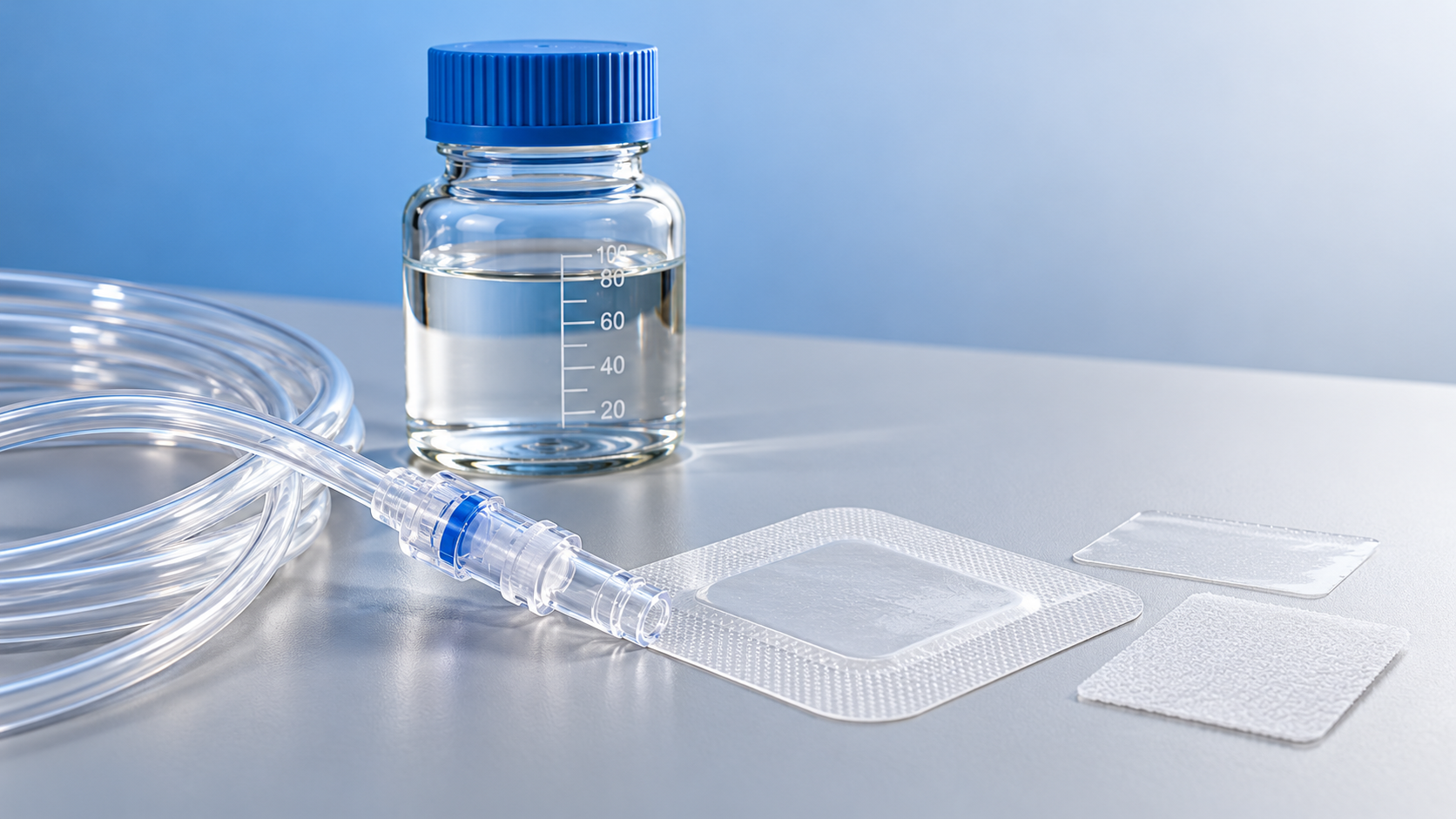
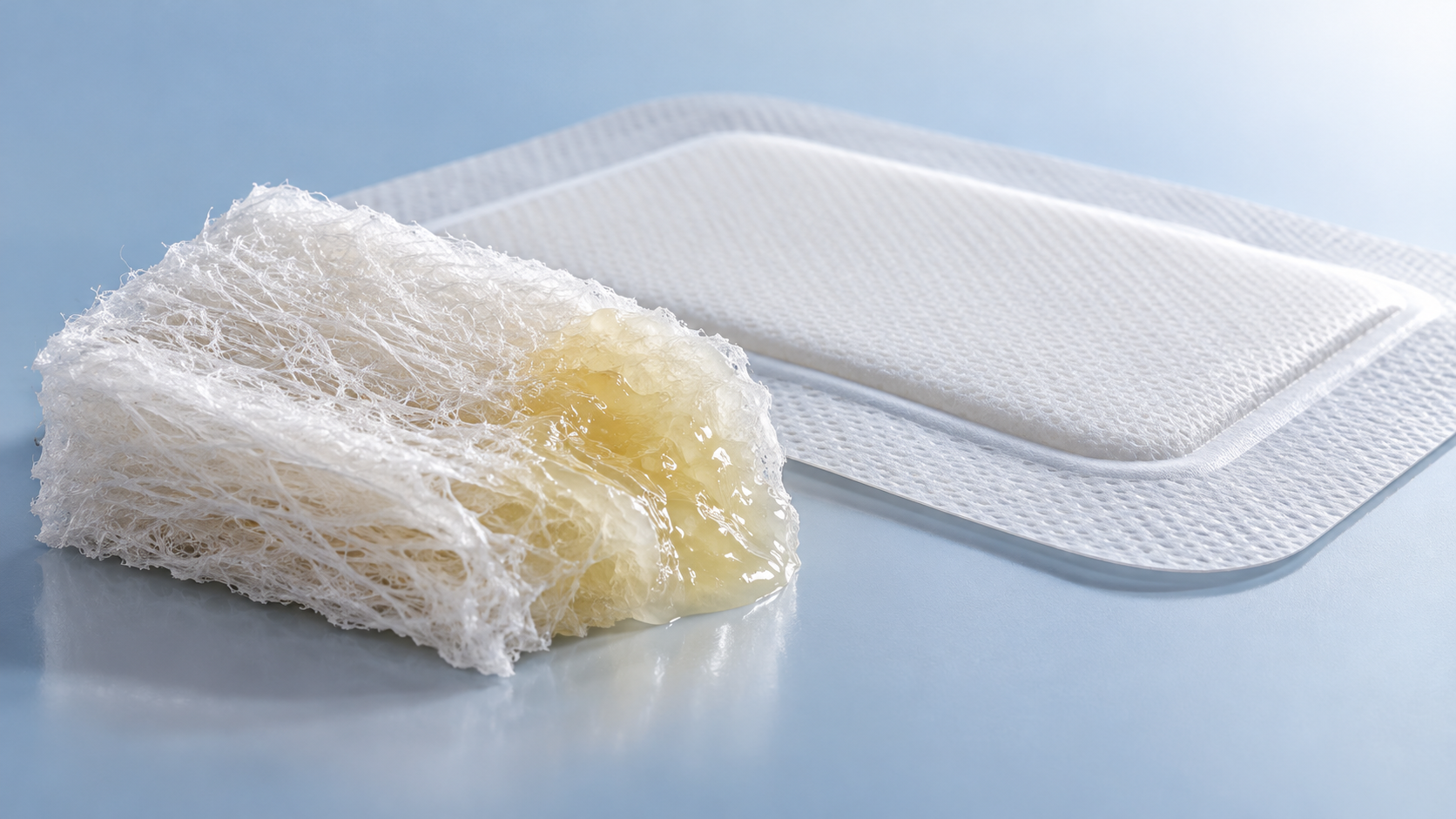
Start with a written description of the proposed application. A silicone adhesive touching intact skin around a wound presents a different exposure from an absorbent layer resting directly on an ulcer. A resorbable matrix placed within a wound needs a different assessment from a removable surface dressing.
Record which components contact the patient, what tissue they contact, and how long exposure lasts. Include substances that can migrate through other layers or enter wound fluid. An adhesive or backing described as “non-contacting” may still contribute extractable chemicals to the patient-contacting surface.
Duration should reflect the intended treatment pattern. Replacing a dressing regularly does not automatically make the overall exposure brief when the same material repeatedly contacts the wound throughout treatment. The biological evaluation should explain how repeated or cumulative contact has been considered.
This exposure description determines whether the supplier’s evidence is relevant. Reports supporting intact-skin contact cannot automatically support use on breached tissue, and evidence for a removable dressing does not automatically support an absorbable scaffold.
Request an evidence package, not an “ISO certificate”
ISO 10993 provides a framework for biological evaluation within a risk management process. It does not provide a universal material approval that transfers to every device or application. A statement such as “ISO 10993 compliant” is useful only when the supporting documentation explains its scope.
Ask for the following documents, with proprietary details shared under an appropriate confidentiality arrangement:
- Material identification: commercial name, grade, formulation revision, specifications, and relevant additives or processing aids.
- Complete laboratory reports: sample descriptions, methods, extraction conditions, controls, results, deviations, and authorized conclusions.
- Biological evaluation documentation: the rationale for selected endpoints, existing evidence, remaining gaps, and the overall safety assessment.
- Manufacturing and treatment information: relevant processing, cleaning, sterilization, packaging, and aging conditions.
- Traceability and change records: links between tested samples and supplied materials, plus changes made since testing.
A raw-material supplier may reasonably provide only part of this package. The finished-device manufacturer remains responsible for assessing the complete product. The purchasing decision should therefore identify both what the supplier’s data supports and what additional evaluation the final manufacturing process requires.
Quality-system certification, sterility documentation, and biological safety reports answer different questions. None should be used as a substitute for the others.
Check whether the tested sample represents what you will receive
The most consequential mismatch is often hidden in the sample description. A report may cover a base polymer while the supplied grade contains a pigment, surfactant, antimicrobial agent, or different crosslinking system. Those differences can change the substances released during use.
Match the laboratory sample identifier to the supplier’s product code, formulation revision, manufacturing lot, and production site where relevant. If the report uses an internal development code, request a controlled document connecting that code to the commercial material.
Representative testing can be appropriate when the supplier explains why the chosen sample covers the proposed variants. That rationale should address formulation, patient exposure, processing, and chemical release. A shared polymer name or similar appearance is insufficient.

Review biological endpoints against the actual exposure
ISO 10993-1 frames biological evaluation around the nature and duration of contact, available knowledge, and identified risks. It should not be reduced to a fixed checklist of tests that every wound material must undergo.
Each relevant biological effect needs an adequate evaluation. That may involve existing data, chemical characterization, toxicological assessment, targeted testing, or a combination. A decision to omit testing should have a documented scientific rationale.
Cytotoxicity is a useful screen with a limited scope
Cytotoxicity testing examines whether a sample or its extract damages cells under defined laboratory conditions. Check the method, sample preparation, extraction conditions, controls, and acceptance criteria. A “pass” without this context provides little basis for judging relevance.
Antimicrobial dressings need careful interpretation. An ingredient intended to suppress microorganisms may also affect mammalian cells in an assay. An adverse result requires investigation into release, exposure, and clinical relevance. Neither the antimicrobial claim nor a favorable result from another test resolves that finding.
Irritation and sensitization address different concerns
Irritation concerns local tissue responses; sensitization concerns the potential to trigger an allergic response. Evidence addressing one does not establish the other. Review whether the evaluated formulation includes the adhesives, preservatives, residual monomers, and other substances present in the supplied material.
Consider both the wound-contacting component and any adhesive border. Repeated contact with surrounding skin can create a relevant exposure even when that component does not touch the wound bed.
Broader effects depend on exposure and material behavior
Systemic toxicity, genotoxicity, local effects after implantation, and degradation-related risks may require consideration depending on the product. Absorbable materials raise questions about breakdown products and exposure over time. Blood-contacting applications may require a hemocompatibility assessment, but visible blood in a wound does not by itself define the entire evaluation strategy.
The useful question is whether every relevant biological concern has been addressed with adequate evidence. Requesting every available test can add cost without resolving the actual uncertainty.
Read the methods and chemical assessment behind the conclusion
An endpoint label does not establish whether a study meaningfully challenges the material. Extraction conditions affect what reaches the test system. Review the extraction media, temperature, duration, sample-to-extract ratio, and any dilution or preparation steps.
The conditions should be justified for the material and evaluation purpose. Insufficient extraction can miss relevant substances; overly harsh conditions can produce changes that require interpretation. Porous foams, swelling hydrogels, and absorbent alginates can complicate extraction because they retain liquid or alter the available extract volume.
Read deviations and observations. Unexplained dilution, unusual pH, sample interference, or failed controls can limit the conclusion. A valid report should make these limitations visible and explain their effect on interpretation.
Chemical characterization helps identify what may be released from a material. ISO 10993-18 addresses chemical characterization, while ISO 10993-17 supports toxicological risk assessment of constituents. These approaches can help connect manufacturing chemistry with plausible patient exposure.
Request an assessment that explains which substances were identified, how exposure was estimated, and how toxicological information supports the conclusion. The presence of a chemical does not automatically establish an unacceptable risk; its absence from a short target list does not establish safety either.
For silver-containing materials, evaluate the relevant form and release behavior rather than relying on total silver content alone. For collagen or other biologically sourced materials, source controls, processing residues, and degradation may require attention beyond routine polymer characterization.
Account for sterilization, packaging, and shelf life
Manufacturing can change a material’s biological profile. Cutting, coating, curing, washing, and bonding may leave residues or change chemical release. Sterilization can introduce residues or alter the material, while packaging can contribute substances during storage.
Evidence from an unsterilized raw material therefore needs a documented connection to the finished sterile product. For ethylene oxide processing, residue evaluation is a separate consideration from a general cytotoxicity result. Radiation or other sterilization methods may also require assessment of material changes.
Shelf-life support should consider changes that could affect biological safety, including degradation or interactions with packaging. This does not automatically require repeating every biological test on aged samples. The evaluation should explain which aging-related risks exist and how the evidence addresses them.
Microbiological safety needs separate attention. Biocompatibility testing does not establish sterility, and endotoxin-related pyrogenicity differs from material-mediated pyrogenicity. Documentation should distinguish these questions rather than treating one favorable result as coverage for all of them.
Turn the review into a documented supplier decision
A technically useful qualification record connects each conclusion to evidence. For every relevant biological concern, identify the report or rationale, explain its applicability, and record any unresolved gap. Assign responsibility for closing gaps before the material is released for the proposed use.
Some gaps can be resolved with traceability documents or a defensible comparison between formulations. Others require chemical analysis, toxicological assessment, or additional testing. Repeating a study is unlikely to solve a problem caused by unclear sample identity.
For example, consider a foam supplier offering reports for an uncoated, unsterilized grade while the intended dressing includes an antimicrobial coating and terminal sterilization. Those reports may support knowledge of the base foam. They leave the coating, processing changes, and final exposure to be evaluated before the finished construction can be supported.
Laboratory competence also deserves review. Examine the laboratory’s relevant capabilities, applicable accreditation scope, and report authorization. Accreditation strengthens confidence in work within its scope; it does not establish that the sponsor selected a representative sample or an adequate evaluation strategy.
Close the qualification with a change-notification agreement covering formulation, raw-material source, processing, production site, and other changes that could affect biological safety. Define how changes will be assessed before affected material is accepted.
The final record should state a specific boundary: which material revision is supported, for which application, under which processing conditions, and with which remaining actions. That boundary makes the supplier’s biocompatibility data usable for purchasing and product decisions.
Get weekly intelligence in your inbox.
No noise. No sponsored content. Pure intelligence.
News Recommendations
 Oct 26, 2026Can a single approval cover life science product sales worldwide?Can a single approval cover life science product sales worldwide?
 Oct 25, 2026When is sensitization testing needed for medical device biocompatibility?When is sensitization testing needed for medical device biocompatibility?
 Oct 24, 2026How is biocompatibility tested for implantable polymer biomaterials?How is biocompatibility tested for implantable polymer biomaterials?
 Oct 23, 2026How to build reimbursement into an implant commercialization strategyHow to build reimbursement into an implant commercialization strategy
 Oct 22, 2026What clinical evidence do implants need for CE marking under EU MDR?What clinical evidence do implants need for CE marking under EU MDR?
 Oct 21, 2026How to choose disposable laparoscopic stapler reloads for thick tissueHow to choose disposable laparoscopic stapler reloads for thick tissue
 Oct 20, 2026How to assess medical polymer biocompatibility under ISO 10993How to assess medical polymer biocompatibility under ISO 10993
 Oct 19, 2026How do interventional device categories differ in clinical use?How do interventional device categories differ in clinical use?
 Oct 18, 2026When to choose alginate dressings for heavily exuding chronic woundsWhen to choose alginate dressings for heavily exuding chronic wounds
 Oct 17, 2026How is biocompatibility tested for custom medical-grade PEEK implants?How is biocompatibility tested for custom medical-grade PEEK implants?
 Oct 16, 2026How to check a wound healing materials supplier’s biocompatibility dataHow to check a wound healing materials supplier’s biocompatibility data
 Oct 15, 2026How to verify the FDA clearance status of silver wound dressingsHow to verify the FDA clearance status of silver wound dressings
 Oct 14, 2026How to register orthopedic implants and instruments in Latin AmericaHow to register orthopedic implants and instruments in Latin America
 Oct 13, 2026How to use a device market intelligence database to benchmark VBP pricesHow to use a device market intelligence database to benchmark VBP prices
 Oct 12, 2026When should stainless steel orthopedic instruments be replaced?When should stainless steel orthopedic instruments be replaced?
 Oct 11, 2026When are alginate dressings rope the right choice for cavity wounds?When are alginate dressings rope the right choice for cavity wounds?
 Oct 10, 2026When smart minimally invasive technology improves catheter accessWhen smart minimally invasive technology improves catheter access
 Oct 08, 2026Clinical evaluation requirements for cardiovascular implant devices in EuropeClinical evaluation requirements for cardiovascular implant devices in Europe
 Oct 07, 2026What to verify before appointing an artificial joint implants distributorWhat to verify before appointing an artificial joint implants distributor
 Oct 06, 2026How ISO 10993 guides biocompatibility testing for medical materialsHow ISO 10993 guides biocompatibility testing for medical materials
 Oct 05, 2026How to verify an orthopedic implants and instruments exporterHow to verify an orthopedic implants and instruments exporter
 Oct 04, 2026What drives surgical stapling devices price differences in hospital tenders?What drives surgical stapling devices price differences in hospital tenders?
 Oct 03, 2026How to assess a central venous catheter manufacturer's infection-control evidenceHow to assess a central venous catheter manufacturer's infection-control evidence
 Oct 02, 2026How to assess an advanced wound care factory’s quality systemHow to assess an advanced wound care factory’s quality system
 Oct 01, 2026What is driving global medical consumables demand in emerging markets?What is driving global medical consumables demand in emerging markets?
 Sep 30, 2026Implant Material Compliance Testing: Evidence Needed for Regulatory SubmissionImplant Material Compliance Testing: Evidence Needed for Regulatory Submission
 Sep 30, 2026From Corrosion to Fatigue: What Implant Materials Testing Should MeasureFrom Corrosion to Fatigue: What Implant Materials Testing Should Measure