How is biocompatibility tested for implantable polymer biomaterials?
Biocompatibility testing for implantable polymer biomaterials combines chemical characterization, toxicological assessment, and biological testing of a device that represents its finished clinical condition. Under the ISO 10993 framework, the evaluation starts with the implantation site, duration of contact, and expected exposure to substances released from the device. The resulting evidence must address both local tissue responses and effects elsewhere in the body throughout the intended service life, including degradation where relevant.
A polymer name alone cannot establish biological safety. Two implants made from the same base resin can produce different responses because of additives, molding conditions, cleaning residues, surface treatments, packaging, or sterilization. A defensible assessment therefore connects each biological question to the actual device, its processing history, and its clinical exposure.
Define the exposure before selecting tests
The biological evaluation plan establishes what contacts the body and how that contact changes over time. A permanent polymer component contacting bone presents different questions from a blood-contacting vascular implant or a resorbable scaffold. Coatings, adhesives, radiopaque fillers, and delivery components also require consideration when they contribute to patient exposure.
Contact duration follows the applicable ISO 10993 categorization, including cumulative exposure when contact is repeated. For an implant, the relevant period extends beyond placement: early release of processing residues, long-term surface aging, and late-stage degradation can create distinct exposure conditions. A single extraction or observation period rarely represents all three.
Existing evidence has value only when its relevance is demonstrated. Published experience with a polymer family does not establish equivalence between different formulations or manufacturing routes. A useful comparison identifies differences in composition, surface condition, processing, sterilization, contact site, and exposure. Unresolved differences become evidence gaps in the evaluation plan.
Test a representative finished device
Test articles should represent the device after manufacturing, cleaning, sterilization, and other processes capable of changing its biological properties. Testing raw resin alone misses residues introduced by machining, mold release agents, bonding, printing, or assembly. Where several device sizes share a design, selection of a representative configuration requires an exposure-based rationale.
The largest implant is not automatically the most challenging configuration. A smaller porous component can have greater accessible surface area, while a different size could contain more adhesive or coating relative to its tissue contact area. Chemical release and physical tissue interaction may therefore require different representative specimens.
Sample preparation also affects interpretation. Cutting a device exposes internal surfaces that do not normally contact tissue; grinding it can radically change extraction behavior. When such preparation is necessary, the report should explain how the resulting exposure relates to clinical use. Retained processing aids, particulate contamination, and sterilization-related changes deserve explicit attention.
Aging is relevant when storage changes the polymer, packaging interaction, or residual profile. Accelerated aging needs a justified relationship to the mechanisms being assessed; elevated temperature can create reactions that are unrepresentative of ordinary storage. Mechanical conditioning also matters for devices that generate wear particles during use.
Chemical characterization establishes what the body could encounter
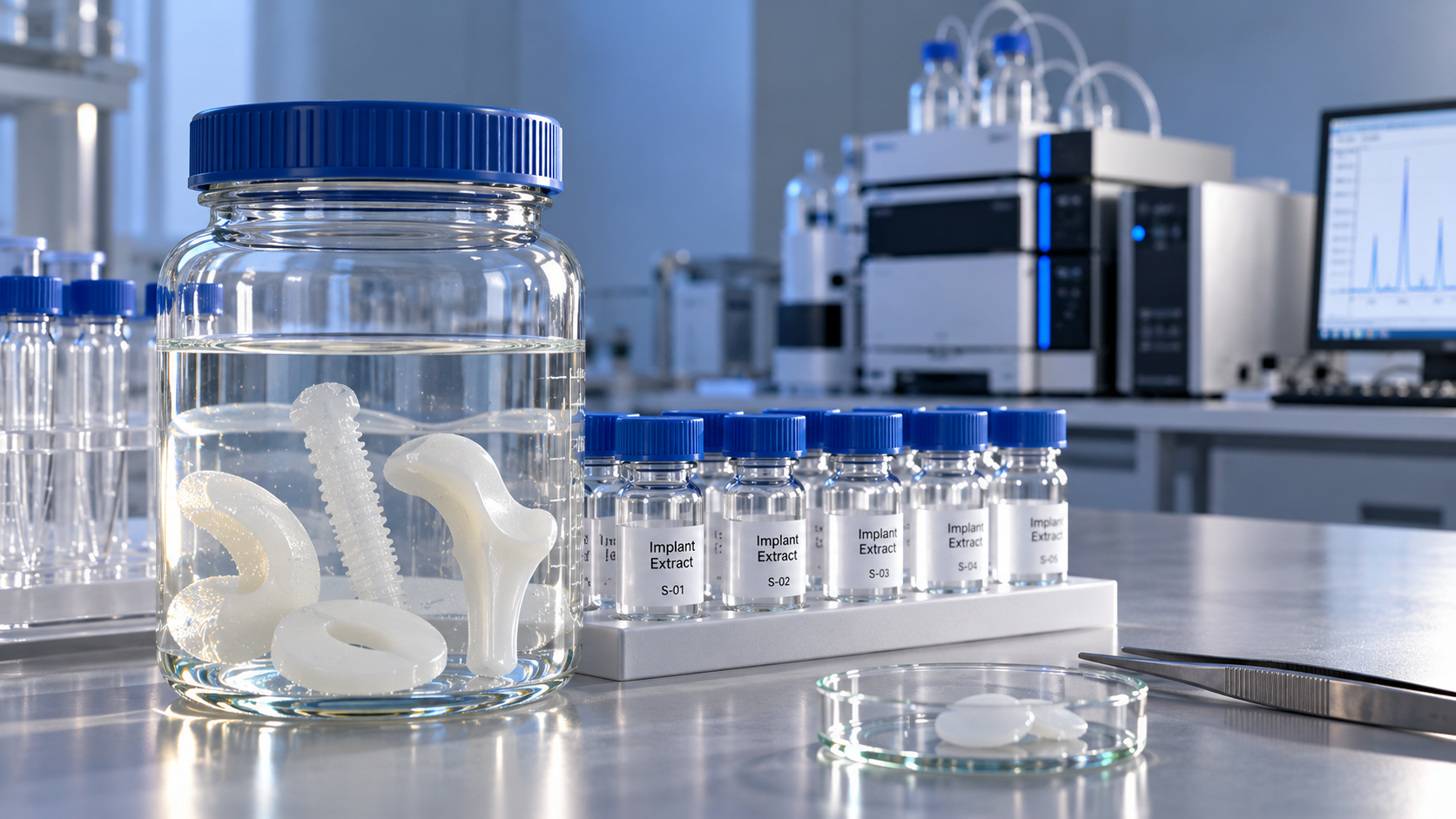
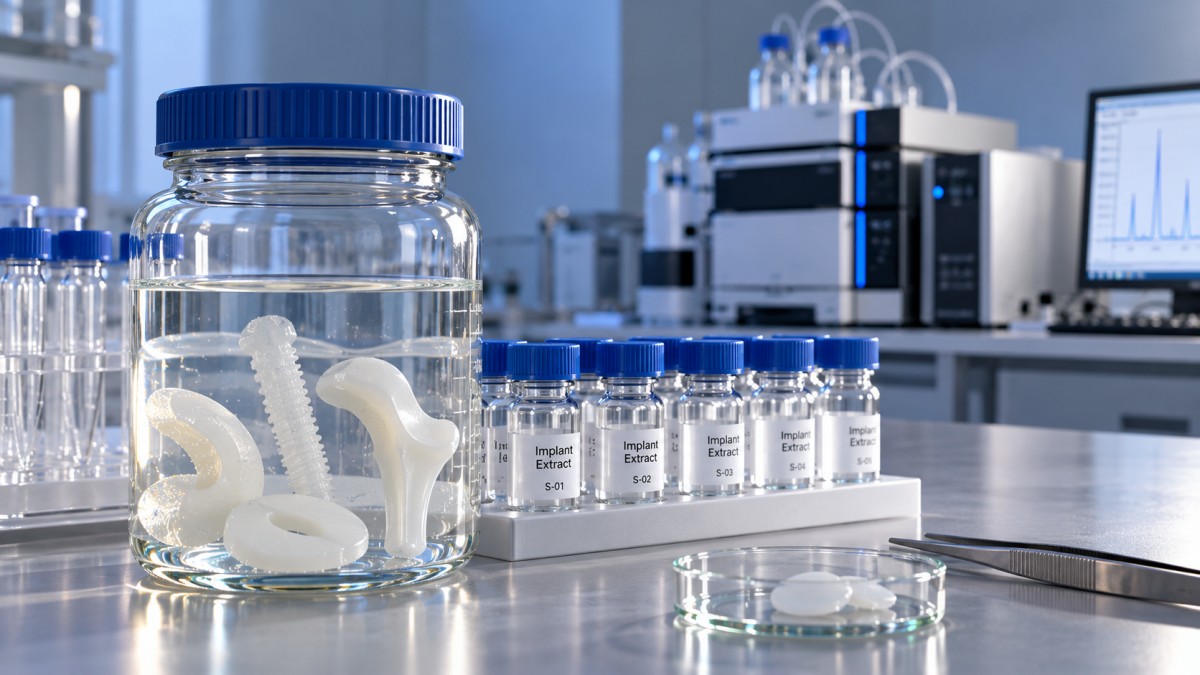
Chemical characterization under ISO 10993-18 investigates constituents and substances released from the device. Information about formulation and processing guides analytical methods, but laboratory analysis is often needed to identify residual monomers, oligomers, additives, catalysts, solvents, and processing contaminants.
Extractables studies use controlled laboratory conditions to reveal substances that could be released. Leachables investigations address release under conditions relevant to clinical exposure. An aggressive extraction can support hazard identification, but its measured concentration does not automatically represent the dose reaching a patient.
Extraction conditions require particular care with polymers. Solvent polarity, temperature, duration, and surface-area-to-volume ratio affect recovery. A solvent that swells or dissolves the material can produce a chemical profile dominated by extraction-induced changes. Conversely, an extraction that poorly recovers hydrophobic additives can understate potential exposure. The study must distinguish purposeful exhaustive extraction from clinically representative release testing.
Analytical coverage commonly combines methods suited to volatile, semivolatile, nonvolatile, and elemental constituents. No single instrument detects every relevant substance. Method sensitivity, recovery, blank contamination, and identification confidence determine whether the chemical profile supports a meaningful assessment. An analytical evaluation threshold guides reporting and identification under the study assumptions; it is not a universal boundary between safe and unsafe chemicals.
Toxicological risk assessment, addressed in ISO 10993-17, translates chemical findings into exposure estimates and evaluates them against appropriate toxicological information. The calculation needs a credible release pattern, number of implanted devices, route of exposure, and patient population. Treating the entire extracted amount as a daily dose indefinitely can distort the assessment, while averaging an initial burst over years can conceal an important early exposure.
Unidentified substances and uncertain quantities limit the strength of the conclusion. Additional analysis, improved process controls, or targeted testing can resolve those gaps. Chemical assessment can support the omission of certain biological tests when the rationale is sufficient, but it cannot fully describe physical tissue irritation, surface-mediated thrombosis, or responses to persistent particles.
Select biological endpoints according to the remaining questions
ISO 10993-1 provides the framework for selecting relevant biological effects within risk management. Its endpoint approach supports a justified evaluation rather than a fixed package applied to every implant. An endpoint can be addressed through suitable existing information, chemical and toxicological evidence, testing, or a combination of these.
Reproductive and developmental toxicity, carcinogenicity, and other long-term effects require consideration when exposure and hazard information raise relevant concerns. Their evaluation does not automatically require a dedicated animal study for every implant. The rationale must explain how the available evidence addresses the specific concern.
A cytotoxicity result needs context
Cytotoxicity testing under ISO 10993-5 offers a useful early indication of harmful material-related effects. Extract testing examines released substances, while direct-contact approaches also bring the specimen into the cellular test environment. Neither reproduces the full tissue response to implantation.
An unfavorable result warrants investigation into chemical release, processing residues, extraction conditions, and assay behavior. Colored extracts, particles, or adsorption of assay reagents can interfere with some readouts. Such explanations need experimental support; they cannot simply dismiss a positive finding. Conversely, a favorable cytotoxicity result leaves sensitization, chronic toxicity, and local implantation effects unresolved.
Implantation studies must capture the tissue response over time
Implantation testing under ISO 10993-6 examines local effects using an appropriate implantation site, comparison material, and observation schedule. Histopathology assesses features such as inflammatory cell populations, necrosis, fibrosis, vascularization, and tissue ingrowth. Gross appearance alone cannot characterize the biological response.
Timing changes the meaning of the findings. Early inflammation can reflect surgical injury, while persistent or increasing inflammation raises different questions. For a porous implant, tissue ingrowth must be interpreted alongside inflammatory activity and material breakdown. A fibrous capsule is not automatically evidence of failure; its significance depends on tissue site, intended function, thickness, and accompanying pathology.
Specimen geometry and mechanical stability also matter. Micromotion can sustain inflammation even when extract testing is favorable. Sharp edges or implantation trauma can produce local damage unrelated to chemical toxicity. Study design and pathology interpretation need enough context to separate these mechanisms without overlooking their combined clinical effect.
Degradation and blood contact change the testing strategy
Resorbable polymers require assessment of the material as it changes. Hydrolysis or other degradation processes alter molecular weight, mechanical integrity, particle generation, and chemical release. For some degradable polyesters, acidic products can accumulate locally when generation exceeds clearance, particularly within thick or poorly perfused structures.
Testing only the initial device can miss the period of greatest biological challenge. Degradation studies should connect material changes to relevant sampling times, released products, and tissue observations. Mass loss alone is insufficient because molecular-weight reduction and loss of strength can precede visible erosion. Accelerated degradation conditions require justification if they alter the reaction pathway or product profile.
Persistent polymers present different concerns. Wear, oxidation, or environmental stress cracking can create particles and new surface chemistry during service. Particle size, shape, dose, and persistence affect the inflammatory response; a soluble extract does not reproduce these physical interactions.
Blood-contacting implants require endpoint selection consistent with ISO 10993-4 and the actual contact conditions. A low hemolysis result addresses red-cell damage but does not establish resistance to thrombosis. Surface roughness, wettability, adsorbed proteins, coating integrity, and flow all influence blood interactions. Dynamic testing becomes relevant when shear or recirculation materially affects the intended device behavior.
Judge whether the evidence supports the finished implant
The final biological evaluation connects the exposure model, chemical findings, toxicological assessment, and biological results into a reasoned conclusion. Each result needs traceability to the tested configuration, batch, manufacturing state, sterilization treatment, and extraction or exposure conditions. Contradictory findings require resolution rather than selection of the most favorable assay.
Sterility and endotoxin control remain separate requirements: a sterile implant can retain biologically active contaminants, and favorable material biocompatibility results do not establish sterility. Endotoxin testing also does not address every source of material-mediated pyrogenicity.
Subsequent changes reopen the evaluation to the extent that they alter exposure or biological interaction. A new resin source, pigment, cleaning agent, sterilization process, or coating cure can require additional evidence even when the device geometry stays the same. The scope of reassessment follows the change mechanism and the remaining uncertainty, with testing directed at the questions the existing evidence no longer answers.
Get weekly intelligence in your inbox.
No noise. No sponsored content. Pure intelligence.
News Recommendations
 Oct 26, 2026Can a single approval cover life science product sales worldwide?Can a single approval cover life science product sales worldwide?
 Oct 25, 2026When is sensitization testing needed for medical device biocompatibility?When is sensitization testing needed for medical device biocompatibility?
 Oct 24, 2026How is biocompatibility tested for implantable polymer biomaterials?How is biocompatibility tested for implantable polymer biomaterials?
 Oct 23, 2026How to build reimbursement into an implant commercialization strategyHow to build reimbursement into an implant commercialization strategy
 Oct 22, 2026What clinical evidence do implants need for CE marking under EU MDR?What clinical evidence do implants need for CE marking under EU MDR?
 Oct 21, 2026How to choose disposable laparoscopic stapler reloads for thick tissueHow to choose disposable laparoscopic stapler reloads for thick tissue
 Oct 20, 2026How to assess medical polymer biocompatibility under ISO 10993How to assess medical polymer biocompatibility under ISO 10993
 Oct 19, 2026How do interventional device categories differ in clinical use?How do interventional device categories differ in clinical use?
 Oct 18, 2026When to choose alginate dressings for heavily exuding chronic woundsWhen to choose alginate dressings for heavily exuding chronic wounds
 Oct 17, 2026How is biocompatibility tested for custom medical-grade PEEK implants?How is biocompatibility tested for custom medical-grade PEEK implants?
 Oct 16, 2026How to check a wound healing materials supplier’s biocompatibility dataHow to check a wound healing materials supplier’s biocompatibility data
 Oct 15, 2026How to verify the FDA clearance status of silver wound dressingsHow to verify the FDA clearance status of silver wound dressings
 Oct 14, 2026How to register orthopedic implants and instruments in Latin AmericaHow to register orthopedic implants and instruments in Latin America
 Oct 13, 2026How to use a device market intelligence database to benchmark VBP pricesHow to use a device market intelligence database to benchmark VBP prices
 Oct 12, 2026When should stainless steel orthopedic instruments be replaced?When should stainless steel orthopedic instruments be replaced?
 Oct 11, 2026When are alginate dressings rope the right choice for cavity wounds?When are alginate dressings rope the right choice for cavity wounds?
 Oct 10, 2026When smart minimally invasive technology improves catheter accessWhen smart minimally invasive technology improves catheter access
 Oct 08, 2026Clinical evaluation requirements for cardiovascular implant devices in EuropeClinical evaluation requirements for cardiovascular implant devices in Europe
 Oct 07, 2026What to verify before appointing an artificial joint implants distributorWhat to verify before appointing an artificial joint implants distributor
 Oct 06, 2026How ISO 10993 guides biocompatibility testing for medical materialsHow ISO 10993 guides biocompatibility testing for medical materials
 Oct 05, 2026How to verify an orthopedic implants and instruments exporterHow to verify an orthopedic implants and instruments exporter
 Oct 04, 2026What drives surgical stapling devices price differences in hospital tenders?What drives surgical stapling devices price differences in hospital tenders?
 Oct 03, 2026How to assess a central venous catheter manufacturer's infection-control evidenceHow to assess a central venous catheter manufacturer's infection-control evidence
 Oct 02, 2026How to assess an advanced wound care factory’s quality systemHow to assess an advanced wound care factory’s quality system
 Oct 01, 2026What is driving global medical consumables demand in emerging markets?What is driving global medical consumables demand in emerging markets?
 Sep 30, 2026Implant Material Compliance Testing: Evidence Needed for Regulatory SubmissionImplant Material Compliance Testing: Evidence Needed for Regulatory Submission
 Sep 30, 2026From Corrosion to Fatigue: What Implant Materials Testing Should MeasureFrom Corrosion to Fatigue: What Implant Materials Testing Should Measure