Medical Polymer Catheters: Material Choices and Kink Resistance Explained
Why Material Choice Matters in Catheter Performance
Medical polymer catheters are not simple tubes. They are engineered access pathways that must balance softness, stability, and biological safety in very confined anatomy.
That balance is why material choice draws so much attention across cardiovascular intervention, minimally invasive surgery, drainage, infusion, and neurovascular procedures.
A catheter that tracks well but collapses under bending is a risk. One that resists kinking but feels too stiff may damage tissue or reduce procedural control.
In other words, the performance of medical polymer catheters is shaped by a chain of decisions, from resin selection to extrusion, reinforcement, coating, and sterilization.
This is also where the broader IMCS perspective becomes useful. In high-value consumables, material science, precision processing, and Class III regulatory expectations are tightly linked.
For technical evaluation, the most relevant question is rarely which polymer is best in general. It is which combination performs reliably in the intended clinical pathway.
The Core Material Families Behind Medical Polymer Catheters
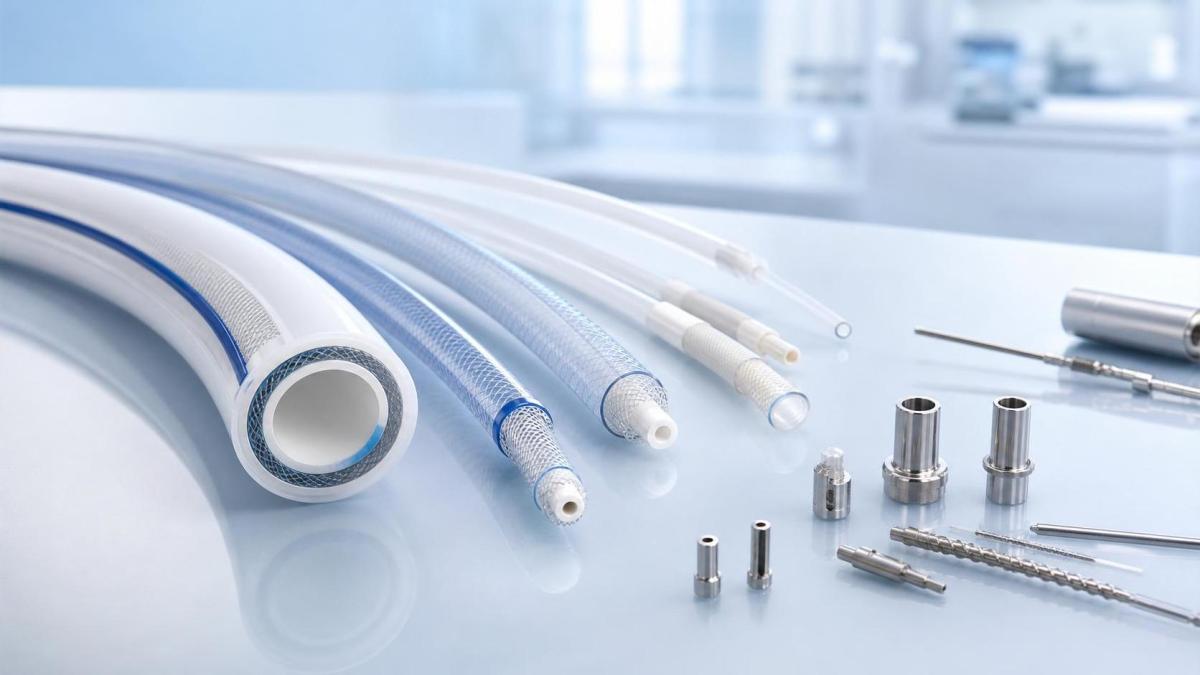
Most medical polymer catheters rely on a limited set of polymer families, but each behaves differently once processed into shafts, balloons, liners, or outer jackets.
Common polymers and what they contribute
PEBAX remains a frequent choice for interventional shafts because hardness can be graded along the catheter length. That helps create a soft distal section with a more supportive proximal body.
Polyurethane is often selected for vascular access and indwelling applications. It offers comfort and versatility, but formulation details influence long-term stability and blood compatibility.
PTFE usually appears as an inner liner rather than a standalone shaft. Its low friction supports guidewire movement, device delivery, and lower insertion resistance.
No single polymer solves every problem. The best medical polymer catheters usually combine multiple layers, each carrying a different mechanical function.
Kink Resistance Is a Design Outcome, Not a Single Property
Kink resistance is often treated as a headline feature, yet it does not come from resin hardness alone. It emerges from geometry, wall structure, reinforcement pattern, and junction design.
A catheter kinks when local compressive stress exceeds the structure’s ability to recover. Once the lumen flattens, flow, device passage, or pressure delivery can deteriorate quickly.
What usually drives kink resistance
- Material modulus and elastic recovery across the shaft
- Wall thickness relative to outer diameter and lumen size
- Braided or coiled reinforcement design
- Transition zones between soft and stiff segments
- Thermal bonding quality and extrusion consistency
Braiding tends to improve torque transmission and crush resistance. Coils can support flexibility and smooth bending. The right answer depends on whether the device navigates coronary, peripheral, urological, or neurovascular routes.
This is why two products using the same polymer may behave very differently. In medical polymer catheters, architecture can matter as much as chemistry.
How Clinical Use Changes the Material Decision
The clinical pathway defines what good performance means. A central venous catheter, a microcatheter, and a drainage catheter face very different loads and failure modes.
Typical application patterns
From an IMCS-style market view, this matters because premium value in medical consumables increasingly comes from targeted fit, not generic material claims.
A catheter positioned for complex anatomy must prove more than basic compliance. It must show repeatable performance under realistic bends, loads, and dwell conditions.
What Deserves Closer Scrutiny During Technical Evaluation
A polished data sheet can hide important weaknesses. Better assessment comes from reading material, process, and test evidence together rather than treating them as separate files.
Practical checkpoints
- Check whether shaft hardness changes are gradual or abrupt. Sharp transitions often create local stress points.
- Review kink testing conditions, not only pass or fail claims. Bend radius, temperature, and loaded state strongly affect results.
- Look for evidence on burst pressure, tensile joints, and fatigue after sterilization.
- Examine coating adhesion and lubricity retention after simulated use.
- Confirm ISO 10993 biocompatibility logic matches contact duration and tissue route.
- Assess whether particulate, extractables, or thrombogenicity risks were addressed where clinically relevant.
For many medical polymer catheters, process capability is the hidden variable. Minor variation in extrusion temperature, braid placement, or reflow bonding can shift performance more than expected.
That is also why regulatory readiness is not only a documentation exercise. Consistency between design intent, verification data, and manufacturing control is the real signal.
Industry Signals Shaping Future Catheter Development
Several industry trends are changing how medical polymer catheters are designed and evaluated. The first is the move toward more complex anatomy with smaller access profiles.
The second is stronger pressure on evidence. CE MDR expectations, deeper clinical evaluation, and stricter post-market scrutiny raise the bar for material justification.
The third is economic. Under cost-control environments and VBP-style pricing pressure, products must defend value through measurable performance, not broad positioning language.
At the same time, innovation continues in hydrophilic coatings, anti-thrombotic surfaces, multi-durometer shafts, and hybrid reinforcement structures. These advances can improve outcomes, but only when supported by solid verification.
For organizations following the IMCS landscape, the catheter segment remains a good example of how biomaterials, micromachining, and regulatory science intersect in one device family.
A Sensible Next Step for Comparison and Selection
When comparing medical polymer catheters, start with the anatomy and dwell condition, then map required properties in order of risk. That usually creates a clearer decision path than starting with brand claims.
It helps to build a short matrix covering polymer system, reinforcement type, kink test method, coating durability, biocompatibility scope, and sterilization compatibility.
If the application is high consequence, request evidence on failure boundaries, not only nominal performance. The most useful insight often comes from seeing where a catheter begins to lose lumen integrity or handling control.
Medical polymer catheters will continue to evolve with smaller profiles, smarter surfaces, and tighter regulations. Better decisions come from connecting material choice to real clinical mechanics, not treating the polymer name as the conclusion.
That approach makes future comparisons more consistent, whether the focus is neurovascular access, cardiovascular delivery, long-term venous use, or the next generation of minimally invasive consumables.
Get weekly intelligence in your inbox.
No noise. No sponsored content. Pure intelligence.
News Recommendations
 Sep 23, 2026How to verify the sterility assurance of surgical devicesHow to verify the sterility assurance of surgical devices
 Sep 22, 2026How to assess a spinal implants manufacturer’s quality systemHow to assess a spinal implants manufacturer’s quality system
 Sep 21, 2026How to assess an osseointegration technology manufacturer’s quality systemHow to assess an osseointegration technology manufacturer’s quality system
 Sep 20, 2026Medical material science trends reshaping biocompatibility testingMedical material science trends reshaping biocompatibility testing
 Sep 19, 2026What North American regulators expect in implant clinical evaluationsWhat North American regulators expect in implant clinical evaluations
 Sep 18, 2026When should plate and screw systems be selected for fracture fixation?When should plate and screw systems be selected for fracture fixation?
 Sep 17, 2026How a medical device sourcing strategy can reduce total acquisition costHow a medical device sourcing strategy can reduce total acquisition cost
 Sep 16, 2026When are silver foam burn care dressings appropriate for exuding burns?When are silver foam burn care dressings appropriate for exuding burns?
 Sep 15, 2026What drives medical device category pricing in value-based purchasing?What drives medical device category pricing in value-based purchasing?
 Sep 14, 2026High value consumables insights for evaluating total cost of careHigh value consumables insights for evaluating total cost of care
 Sep 13, 2026What a medical device market insights platform reveals about market accessWhat a medical device market insights platform reveals about market access
 Sep 12, 2026When are collagen-based tissue healing materials suitable for wound care?When are collagen-based tissue healing materials suitable for wound care?
 Sep 11, 2026How catheter material selection affects total cost of ownershipHow catheter material selection affects total cost of ownership
 Sep 10, 2026What FDA clearance means for medical grade PEEK implantsWhat FDA clearance means for medical grade PEEK implants
 Sep 09, 2026When do hydrogel wound healing technologies suit dry wounds?When do hydrogel wound healing technologies suit dry wounds?
 Sep 07, 2026How to assess medical consumables for surgical useHow to assess medical consumables for surgical use
 Sep 07, 2026How to verify CE MDR compliance for single-use medical consumablesHow to verify CE MDR compliance for single-use medical consumables
 Sep 05, 2026How to evaluate an antithrombotic catheter factory for qualityHow to evaluate an antithrombotic catheter factory for quality
 Sep 04, 2026When do minimally invasive surgical staplers improve GI access?When do minimally invasive surgical staplers improve GI access?
 Sep 03, 2026When are foam moist wound healing dressings appropriate for exuding wounds?When are foam moist wound healing dressings appropriate for exuding wounds?
 Sep 02, 2026How implant pricing affects access to advanced medical careHow implant pricing affects access to advanced medical care
 Sep 01, 2026What is driving price pressure in the North American medical consumables market?What is driving price pressure in the North American medical consumables market?
 Aug 31, 2026Comparing medical devices in Southeast Asia when market access differsComparing medical devices in Southeast Asia when market access differs
 Aug 30, 2026When are 3D printed PEEK implants suitable for spinal reconstruction?When are 3D printed PEEK implants suitable for spinal reconstruction?
 Aug 29, 2026How global medical device regulations shape clinical evidence requirementsHow global medical device regulations shape clinical evidence requirements
 Aug 28, 2026How to verify a burn care dressings exporter meets EU MDR requirementsHow to verify a burn care dressings exporter meets EU MDR requirements
 Aug 27, 2026How to verify a diabetic foot wound care supplier’s clinical evidenceHow to verify a diabetic foot wound care supplier’s clinical evidence