What FDA clearance means for medical grade PEEK implants
What FDA Clearance Means for Medical Grade PEEK Implants
For a technical evaluator, the phrase “FDA-cleared PEEK implant” should trigger more questions than conclusions. It is a useful regulatory signal, but it is not a universal certificate for the polymer, a manufacturing site, or every possible implant configuration made from that polymer. It means that the FDA has reviewed a specific medical device submission and allowed a defined device, for a defined intended use, to be marketed in the United States under its applicable pathway.
That distinction matters particularly for polyether ether ketone. PEEK has a long history in implantable applications, especially spinal devices, because its modulus is closer to bone than many metallic implant materials and because it is radiolucent on conventional imaging. Yet a material property does not establish device safety. A PEEK interbody cage, an anchoring component, a craniofacial plate, and a PEEK-containing instrument may have very different contact conditions, loading profiles, sterilization methods, geometries, and clinical risks.
The practical question is therefore not, “Is medical grade PEEK FDA approved?” It is: “What exactly was cleared or approved, for which indication, with what technological characteristics, and on what evidence?” That is the level at which a sound technical and regulatory review begins.
Clearance, approval, and material qualification are not interchangeable
In U.S. device regulation, “FDA clearance” most commonly refers to the 510(k) process. In a 510(k), the manufacturer generally demonstrates that its device is substantially equivalent to a legally marketed predicate device. The review is device-specific. It considers intended use and technological characteristics, and it may require performance evidence where differences from the predicate raise new questions of safety or effectiveness.
“FDA approval” usually refers to a different pathway, such as Premarket Approval (PMA), which applies to certain higher-risk devices. Whether a PEEK-based implant is regulated through 510(k), PMA, De Novo classification, or another mechanism depends on the device type and classification rather than on the fact that PEEK is present. A spinal implant system may include a PEEK component but still have its own product code, classification, and submission history that must be checked directly.
There is also no simple FDA-issued status called “medical grade PEEK” that automatically transfers from resin supplier to finished implant. In industry, the term usually indicates that a polymer grade has been selected, controlled, documented, and supported for medical-device use. That may involve material specifications, traceability, extractables information, processing guidance, and prior biocompatibility data. Valuable as that package may be, it does not replace finished-device validation.
A frequent review error is to accept a resin supplier’s biocompatibility letter as if it were evidence for the final implant. Machining, thermal history, additives, colorants, cleaning chemistry, packaging, and sterilization can all alter the finished article’s risk profile. The evaluated object is the device placed in the patient—not an untouched pellet of PEEK in a supplier’s laboratory.
What a clearance letter actually tells you
A clearance letter and its associated public record can confirm meaningful facts, but it should be read with discipline. It normally identifies the applicant, device name, submission number, decision date, and the cleared indication for use. The FDA’s 510(k) database and, where available, the summary documentation provide a starting point for checking the regulatory claim.
For an implant evaluator, the intended-use statement is often more revealing than the device’s marketing name. A PEEK cage cleared for use in a specified spinal procedure is not automatically cleared for another anatomy, a revised fixation strategy, a different patient population, or a biologic-loading claim. Even a seemingly modest change—from an unfilled PEEK body to a carbon-fiber-reinforced PEEK construct, or from machined PEEK to an additively manufactured architecture—can change the scientific questions that need to be addressed.
Clearance also does not mean the FDA has made a blanket finding that the device will perform safely for decades in every patient. The agency’s decision is tied to the submitted device and the evidence supporting its market entry. Long-term outcomes continue to depend on surgical technique, patient anatomy, indication selection, implant positioning, adjacent hardware, rehabilitation, and post-market experience.
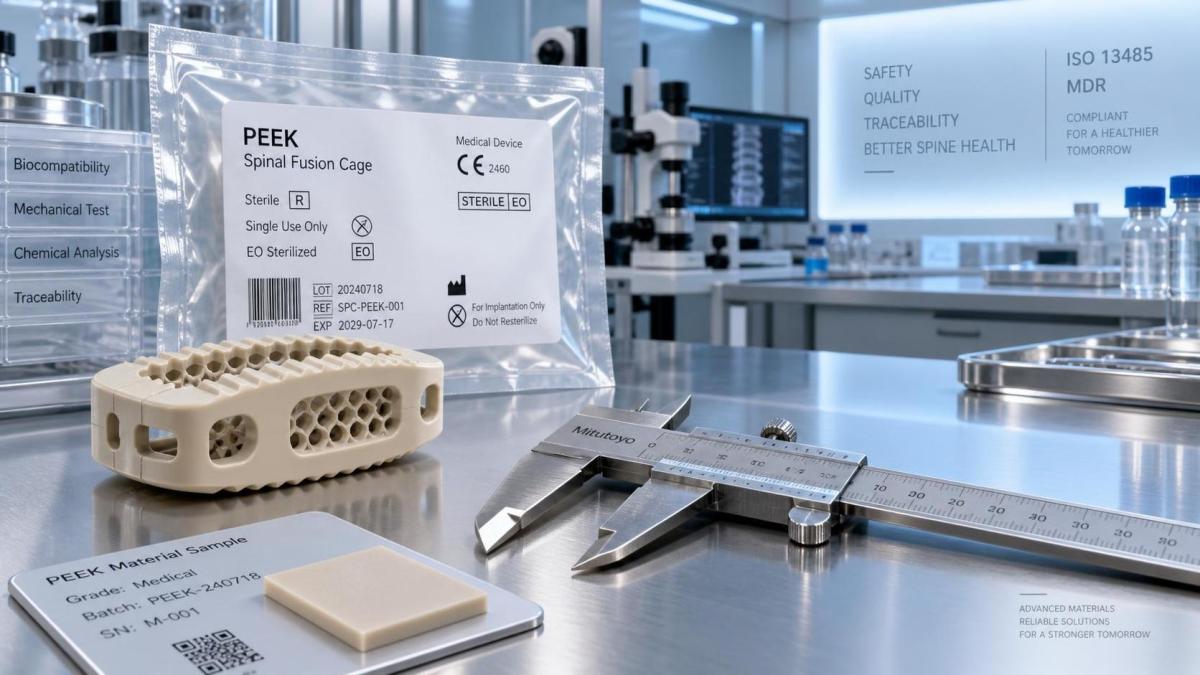
The evidence behind a PEEK implant is broader than a biocompatibility test
Biological evaluation is essential, but it is only one part of the file. The ISO 10993 series is widely used as a framework for biological evaluation of medical devices, with the biological risk assessment driven by the nature and duration of body contact. For an implant intended for prolonged or permanent contact, evaluators typically expect a documented rationale that connects material composition, manufacturing residues, clinical exposure, and available test evidence. Cytotoxicity and sensitization are familiar checkpoints, but a complete assessment may need to address endpoints such as irritation, systemic toxicity, implantation effects, genotoxicity, chemical characterization, and toxicological risk assessment, depending on the device and its contact category.
The important judgment is not whether every conceivable test appears in a spreadsheet. It is whether the manufacturer has made a defensible, current risk-based case for the finished device. If a legacy material dossier is used, technical reviewers should ask whether it still represents the actual material formulation and production route. A change in pigment, processing lubricant, detergent, sterilization cycle, or packaging adhesive can make an old rationale less persuasive.
Mechanical performance is equally central. PEEK’s relative elasticity may be attractive in load-bearing applications, but implant behavior is determined by the final design. For a spinal cage, for example, reviewers may need to understand static and dynamic compression behavior, subsidence-related design considerations, expulsion resistance where relevant, endplate contact geometry, and interaction with supplemental fixation. The appropriate tests and acceptance rationale must match the device’s indication and predicate comparison; there is no single mechanical test package that proves every PEEK implant is suitable.
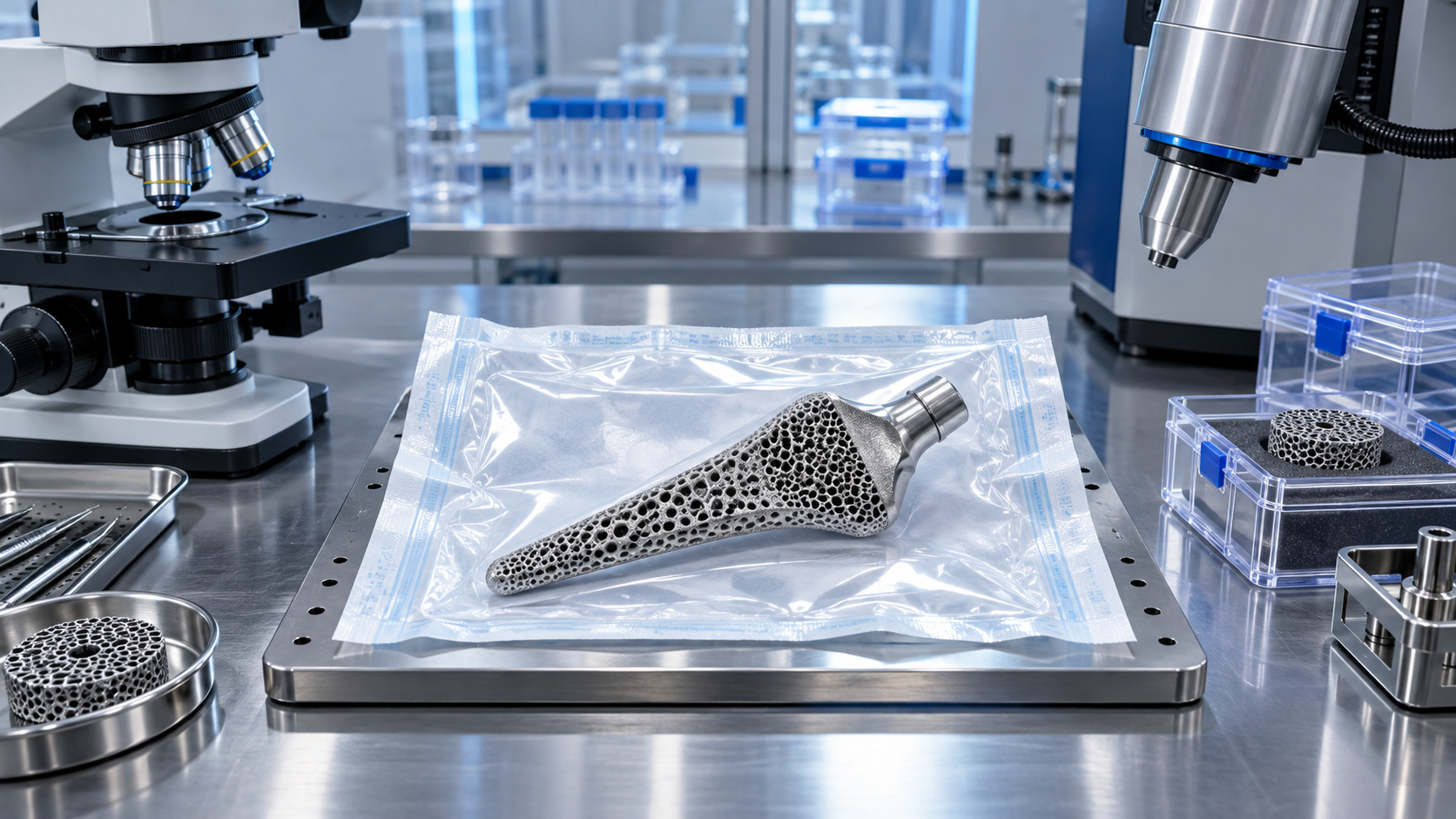
Surface treatment deserves close attention. Conventional PEEK is often described as biologically inert, which can be useful in some respects but may complicate direct bone apposition. Manufacturers may use roughening, porous structures, coatings, or composite approaches to influence the bone-implant interface. Those changes can be clinically purposeful, yet they also introduce questions about coating integrity, particulate release, adhesion, wear, corrosion of any associated metallic layer, and consistency across production lots. “PEEK” is not enough detail when the clinically relevant surface is no longer simply PEEK.
Manufacturing controls can change the regulatory answer
A technically credible PEEK implant program connects design evidence to manufacturing reality. Resin identity and lot traceability matter, but so do drying conditions, melt processing where applicable, machining parameters, particulate control, cleaning validation, and final packaging. PEEK can tolerate demanding processing conditions, yet that does not eliminate the need to control thermal exposure and document the process window. A device made from nominally identical resin can behave differently if its geometry, residual stress, surface finish, or contamination profile changes.
Sterilization is another point where teams sometimes make overly easy assumptions. The selected method must be compatible with the finished device, packaging system, shelf-life claim, and any ancillary materials. Sterilization validation does not stand apart from material assessment: it may affect chemical characterization, mechanical properties, or packaging integrity. If the commercial device is supplied sterile, the regulatory evidence should represent that final sterile configuration rather than a pre-sterilization sample.
For organizations managing high-value consumables across implants, catheters, staplers, and wound-care systems, this lesson carries beyond PEEK. Material selection, micron-level manufacturing precision, and regulatory documentation are not separate workstreams that can be stitched together at the end. In implant systems especially, the interfaces are where avoidable problems emerge: polymer to coating, cage to endplate, implant to inserter, validated process to scaled production.
How to review an FDA claim without over-reading it
A useful technical review usually starts with a small set of documents rather than a broad request for “all certificates.” Ask for the exact FDA submission reference, the cleared indication for use, the device description, and the predicate comparison. Then compare the commercial configuration under review against that record. Are the PEEK grade, implant geometry, surface condition, sterilization method, accessories, and labeling aligned? If the answer is unclear, the regulatory status should be treated as unverified rather than assumed.
- Confirm whether the claim is clearance, approval, authorization, registration, or merely establishment listing. These terms describe different things.
- Check that the stated indication matches the clinical application being evaluated, not just the broad anatomical category.
- Trace the finished implant back to its material specification and process controls; a generic PEEK declaration is not enough.
- Review biological evaluation and chemical characterization as a coherent risk assessment, especially after material, supplier, process, or sterilization changes.
- Determine whether surface modifications or composite elements introduce risks that the base-polymer history does not address.
This is also where post-market discipline matters. A cleared device remains subject to applicable FDA requirements, including quality-system and reporting obligations. Complaints, adverse-event signals, field actions, and design changes can reveal whether the original evidence package still reflects real-world performance. Regulatory clearance is an entry point to the market, not the end of technical surveillance.
Why the distinction matters in global implant decisions
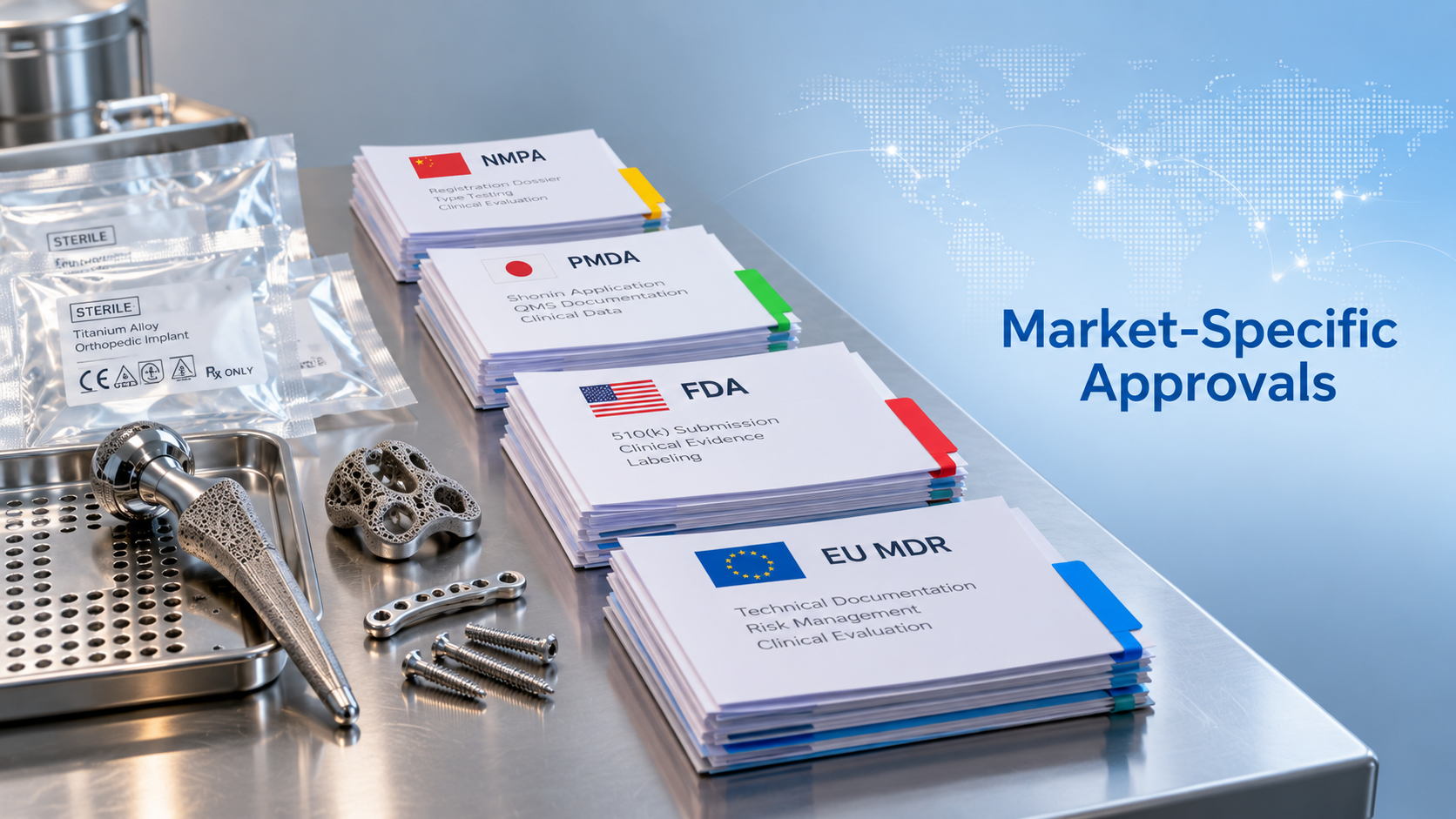
FDA status can be influential in global due diligence, but it should not be treated as a substitute for other jurisdictions’ requirements. A U.S. 510(k) does not itself establish conformity under the EU Medical Device Regulation, nor does it resolve local registration, clinical-evaluation, labeling, or reimbursement questions. For manufacturers working across regulated implant markets, a disciplined evidence map is more useful than a collection of disconnected certificates.
That is particularly relevant when commercial pressure encourages rapid material substitution or portfolio expansion. PEEK can support compelling implant designs, and its imaging characteristics remain highly relevant in spine and other applications. But the best technical decision is rarely “use PEEK because PEEK is cleared.” It is to establish whether this particular PEEK implant, in this configuration, for this clinical use, has evidence that remains consistent from raw material through sterilized product and into post-market monitoring.
For evaluators, the most reliable conclusion is usually a precise one: FDA clearance may support the market status of a defined medical device, but it does not confer a blanket approval on medical grade PEEK, on every derivative design, or on long-term performance outside the cleared indication. When that boundary is documented clearly, both regulatory and engineering decisions become harder to misinterpret.
Get weekly intelligence in your inbox.
No noise. No sponsored content. Pure intelligence.
News Recommendations
 Oct 26, 2026Can a single approval cover life science product sales worldwide?Can a single approval cover life science product sales worldwide?
 Oct 25, 2026When is sensitization testing needed for medical device biocompatibility?When is sensitization testing needed for medical device biocompatibility?
 Oct 24, 2026How is biocompatibility tested for implantable polymer biomaterials?How is biocompatibility tested for implantable polymer biomaterials?
 Oct 23, 2026How to build reimbursement into an implant commercialization strategyHow to build reimbursement into an implant commercialization strategy
 Oct 22, 2026What clinical evidence do implants need for CE marking under EU MDR?What clinical evidence do implants need for CE marking under EU MDR?
 Oct 21, 2026How to choose disposable laparoscopic stapler reloads for thick tissueHow to choose disposable laparoscopic stapler reloads for thick tissue
 Oct 20, 2026How to assess medical polymer biocompatibility under ISO 10993How to assess medical polymer biocompatibility under ISO 10993
 Oct 19, 2026How do interventional device categories differ in clinical use?How do interventional device categories differ in clinical use?
 Oct 18, 2026When to choose alginate dressings for heavily exuding chronic woundsWhen to choose alginate dressings for heavily exuding chronic wounds
 Oct 17, 2026How is biocompatibility tested for custom medical-grade PEEK implants?How is biocompatibility tested for custom medical-grade PEEK implants?
 Oct 16, 2026How to check a wound healing materials supplier’s biocompatibility dataHow to check a wound healing materials supplier’s biocompatibility data
 Oct 15, 2026How to verify the FDA clearance status of silver wound dressingsHow to verify the FDA clearance status of silver wound dressings
 Oct 14, 2026How to register orthopedic implants and instruments in Latin AmericaHow to register orthopedic implants and instruments in Latin America
 Oct 13, 2026How to use a device market intelligence database to benchmark VBP pricesHow to use a device market intelligence database to benchmark VBP prices
 Oct 12, 2026When should stainless steel orthopedic instruments be replaced?When should stainless steel orthopedic instruments be replaced?
 Oct 11, 2026When are alginate dressings rope the right choice for cavity wounds?When are alginate dressings rope the right choice for cavity wounds?
 Oct 10, 2026When smart minimally invasive technology improves catheter accessWhen smart minimally invasive technology improves catheter access
 Oct 08, 2026Clinical evaluation requirements for cardiovascular implant devices in EuropeClinical evaluation requirements for cardiovascular implant devices in Europe
 Oct 07, 2026What to verify before appointing an artificial joint implants distributorWhat to verify before appointing an artificial joint implants distributor
 Oct 06, 2026How ISO 10993 guides biocompatibility testing for medical materialsHow ISO 10993 guides biocompatibility testing for medical materials
 Oct 05, 2026How to verify an orthopedic implants and instruments exporterHow to verify an orthopedic implants and instruments exporter
 Oct 04, 2026What drives surgical stapling devices price differences in hospital tenders?What drives surgical stapling devices price differences in hospital tenders?
 Oct 03, 2026How to assess a central venous catheter manufacturer's infection-control evidenceHow to assess a central venous catheter manufacturer's infection-control evidence
 Oct 02, 2026How to assess an advanced wound care factory’s quality systemHow to assess an advanced wound care factory’s quality system
 Oct 01, 2026What is driving global medical consumables demand in emerging markets?What is driving global medical consumables demand in emerging markets?
 Sep 30, 2026Implant Material Compliance Testing: Evidence Needed for Regulatory SubmissionImplant Material Compliance Testing: Evidence Needed for Regulatory Submission
 Sep 30, 2026From Corrosion to Fatigue: What Implant Materials Testing Should MeasureFrom Corrosion to Fatigue: What Implant Materials Testing Should Measure