Clinical Evaluation of Medical Devices: Key Evidence and Common Gaps
Clinical Evaluation of Medical Devices: Key Evidence and Common Gaps
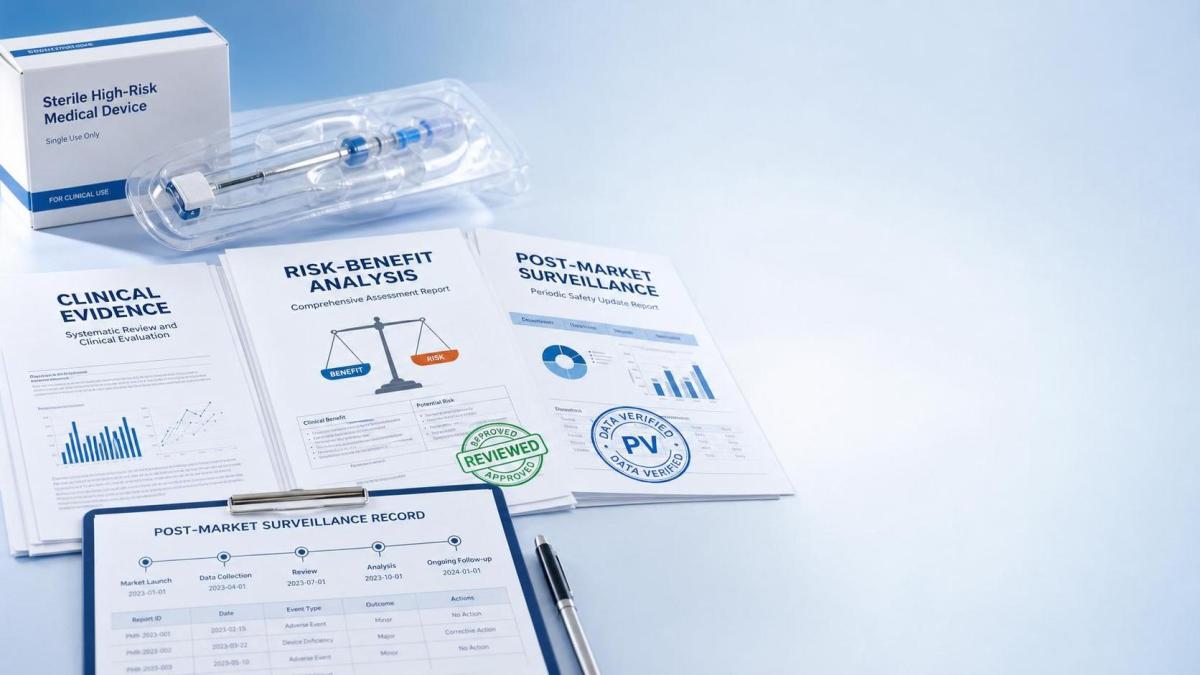
Medical device clinical evaluation sits at the center of modern market access. It proves whether a device is safe, performs as intended, and delivers a real clinical benefit.
That sounds straightforward. In practice, it rarely is. The pressure comes from stricter MDR expectations, evolving global guidance, and a higher bar for evidence quality.
For high-risk implants and consumables, the problem is usually not missing documents. The real issue is weak logic between data sources, claims, risks, and clinical conclusions.
A strong medical device clinical evaluation should answer four basic questions clearly. What is the device supposed to do, for whom, under which conditions, and with what level of evidence?
This becomes even more important for orthopedic implants, cardiovascular devices, surgical staplers, polymer catheters, and advanced wound care systems, where risk tolerance is low.
From a technical evaluation perspective, the goal is not to collect everything. The goal is to build a defensible evidence chain that stands up to scientific and regulatory scrutiny.
What a Clinical Evaluation Must Demonstrate
A medical device clinical evaluation should connect intended purpose, design features, risk profile, and clinical outcomes. If one link is weak, the full argument starts to wobble.
At a minimum, the evaluation should show:
- Clinical safety under normal and reasonably foreseeable use
- Clinical performance aligned with the device claims
- A favorable benefit-risk profile across the target population
- Sufficient evidence relevance to the exact device configuration
- Ongoing confirmation through post-market clinical follow-up
This is where many teams underestimate scope. Clinical evidence is not only about published studies. It includes complaint trends, registry signals, vigilance records, and post-market experience.
More importantly, not all evidence carries equal weight. A small retrospective paper cannot automatically support broad claims for a Class III implant with long-term performance demands.
Key Evidence Sources in Medical Device Clinical Evaluation
A robust medical device clinical evaluation usually blends several evidence streams. The art lies in showing why each source is relevant and where its limits begin.
Clinical Investigation Data
This remains the most direct evidence. For novel devices, new indications, or meaningful design changes, clinical investigation data often carries the highest value.
It should reflect the actual device, target population, clinical endpoints, and use conditions. Follow-up duration must also match the expected clinical risks and benefit timeline.
Scientific Literature
Literature is often the backbone of a medical device clinical evaluation, especially for established technologies. Still, relevance matters more than article volume.
A literature set should be systematic, transparent, and reproducible. Search strings, databases, inclusion criteria, and screening logic must be documented well enough to be audited.
Equivalent Device Evidence
Equivalence can support a clinical evaluation, but it is commonly overstretched. Technical, biological, and clinical equivalence all need to be demonstrated together.
That means materials, design principles, contact characteristics, indications, anatomical site, user profile, and performance expectations should align closely, not loosely.
Post-Market Data
Real-world data adds practical depth. Complaint handling, trend reports, serious incident analysis, field safety actions, and registry outcomes can reveal what pre-market studies miss.
For long-term implants, post-market data is especially useful because many failure modes appear later, not during early enrollment windows.
Common Gaps That Weaken the Evidence Package
Most weak submissions do not fail because evidence is absent. They fail because the medical device clinical evaluation does not connect evidence to claims in a precise way.
1. Device Description Is Too Broad
A vague device description creates trouble early. Evaluators cannot judge relevance if materials, dimensions, coatings, software functions, or delivery mechanisms remain poorly defined.
This often happens in product families. One report tries to cover many variants, but the justification for grouping is too thin.
2. Literature Search Is Not Truly Systematic
A common gap is selective literature use. Teams cite favorable studies, but they do not explain exclusion logic, negative findings, or publication bias risk.
That undermines trust fast. A systematic review method is not a formality. It is proof that the evaluation process was balanced and evidence-led.
3. Equivalence Claims Are Too Aggressive
This is one of the biggest pressure points. A similar-looking device is not necessarily an equivalent device.
Small differences may change tissue response, fatigue behavior, migration risk, deliverability, or long-term patency. That is particularly true in stents, valves, and implants.
4. Risk-Benefit Discussion Is Generic
Some reports summarize benefits and risks separately, but never weigh them against each other. That leaves the final conclusion unsupported.
A sound medical device clinical evaluation should discuss severity, frequency, uncertainty, mitigation, alternatives, and residual risk in one integrated narrative.
5. Post-Market Clinical Follow-Up Is Weak
PMCF is often treated as a future task. Regulators see it differently. It is a live mechanism to confirm assumptions and detect emerging clinical concerns.
When PMCF plans lack endpoints, timelines, populations, or trigger criteria, the entire clinical strategy looks underpowered.
Practical Review Points for High-Risk Devices
In real projects, high-risk device reviews move faster when technical evaluators use a structured challenge list. That keeps discussions objective and evidence-focused.
- Check whether intended purpose matches every clinical claim.
- Confirm that study populations reflect actual users and indications.
- Compare endpoint quality, not only endpoint presence.
- Test whether literature covers worst-case design features.
- Review equivalence across technical, biological, and clinical dimensions.
- Map adverse events against the risk management file.
- Look for gaps between pre-market assumptions and post-market signals.
This checklist matters because many evidence packages look polished on the surface. The weaknesses usually appear only after cross-checking sources against the intended use and risk file.
A Simple Gap Matrix for Better Clinical Evaluation
One practical way to improve medical device clinical evaluation is to use a gap matrix before finalizing the report. It helps turn broad concerns into concrete actions.
This kind of tool is especially useful for implants and interventional products, where evidence needs to remain coherent across engineering, biocompatibility, and long-term clinical performance.
How Stronger Evidence Supports Better Decisions
A better medical device clinical evaluation does more than satisfy a regulatory checkpoint. It improves internal decision-making across design, claims, labeling, and post-market planning.
It also reduces friction later. When evidence gaps are found early, teams can refine PMCF plans, narrow unsupported claims, or generate targeted clinical data before delays become expensive.
For organizations working with Class III technologies, that discipline is not optional. It is part of staying credible in a market shaped by strict safety expectations and tighter reimbursement pressure.
The clearest takeaway is simple. Medical device clinical evaluation works best when evidence is relevant, traceable, critical, and connected to the real clinical context.
If the current file still relies on broad claims, weak equivalence, or thin post-market logic, start there. Tightening those areas usually creates the fastest and most defensible improvement.
Get weekly intelligence in your inbox.
No noise. No sponsored content. Pure intelligence.
News Recommendations
 Sep 23, 2026How to verify the sterility assurance of surgical devicesHow to verify the sterility assurance of surgical devices
 Sep 22, 2026How to assess a spinal implants manufacturer’s quality systemHow to assess a spinal implants manufacturer’s quality system
 Sep 21, 2026How to assess an osseointegration technology manufacturer’s quality systemHow to assess an osseointegration technology manufacturer’s quality system
 Sep 20, 2026Medical material science trends reshaping biocompatibility testingMedical material science trends reshaping biocompatibility testing
 Sep 19, 2026What North American regulators expect in implant clinical evaluationsWhat North American regulators expect in implant clinical evaluations
 Sep 18, 2026When should plate and screw systems be selected for fracture fixation?When should plate and screw systems be selected for fracture fixation?
 Sep 17, 2026How a medical device sourcing strategy can reduce total acquisition costHow a medical device sourcing strategy can reduce total acquisition cost
 Sep 16, 2026When are silver foam burn care dressings appropriate for exuding burns?When are silver foam burn care dressings appropriate for exuding burns?
 Sep 15, 2026What drives medical device category pricing in value-based purchasing?What drives medical device category pricing in value-based purchasing?
 Sep 14, 2026High value consumables insights for evaluating total cost of careHigh value consumables insights for evaluating total cost of care
 Sep 13, 2026What a medical device market insights platform reveals about market accessWhat a medical device market insights platform reveals about market access
 Sep 12, 2026When are collagen-based tissue healing materials suitable for wound care?When are collagen-based tissue healing materials suitable for wound care?
 Sep 11, 2026How catheter material selection affects total cost of ownershipHow catheter material selection affects total cost of ownership
 Sep 10, 2026What FDA clearance means for medical grade PEEK implantsWhat FDA clearance means for medical grade PEEK implants
 Sep 09, 2026When do hydrogel wound healing technologies suit dry wounds?When do hydrogel wound healing technologies suit dry wounds?
 Sep 07, 2026How to assess medical consumables for surgical useHow to assess medical consumables for surgical use
 Sep 07, 2026How to verify CE MDR compliance for single-use medical consumablesHow to verify CE MDR compliance for single-use medical consumables
 Sep 05, 2026How to evaluate an antithrombotic catheter factory for qualityHow to evaluate an antithrombotic catheter factory for quality
 Sep 04, 2026When do minimally invasive surgical staplers improve GI access?When do minimally invasive surgical staplers improve GI access?
 Sep 03, 2026When are foam moist wound healing dressings appropriate for exuding wounds?When are foam moist wound healing dressings appropriate for exuding wounds?
 Sep 02, 2026How implant pricing affects access to advanced medical careHow implant pricing affects access to advanced medical care
 Sep 01, 2026What is driving price pressure in the North American medical consumables market?What is driving price pressure in the North American medical consumables market?
 Aug 31, 2026Comparing medical devices in Southeast Asia when market access differsComparing medical devices in Southeast Asia when market access differs
 Aug 30, 2026When are 3D printed PEEK implants suitable for spinal reconstruction?When are 3D printed PEEK implants suitable for spinal reconstruction?
 Aug 29, 2026How global medical device regulations shape clinical evidence requirementsHow global medical device regulations shape clinical evidence requirements
 Aug 28, 2026How to verify a burn care dressings exporter meets EU MDR requirementsHow to verify a burn care dressings exporter meets EU MDR requirements
 Aug 27, 2026How to verify a diabetic foot wound care supplier’s clinical evidenceHow to verify a diabetic foot wound care supplier’s clinical evidence