Catheter Material Selection for Vascular Access: Key Risks
Catheter Material Selection for Vascular Access: Key Risks
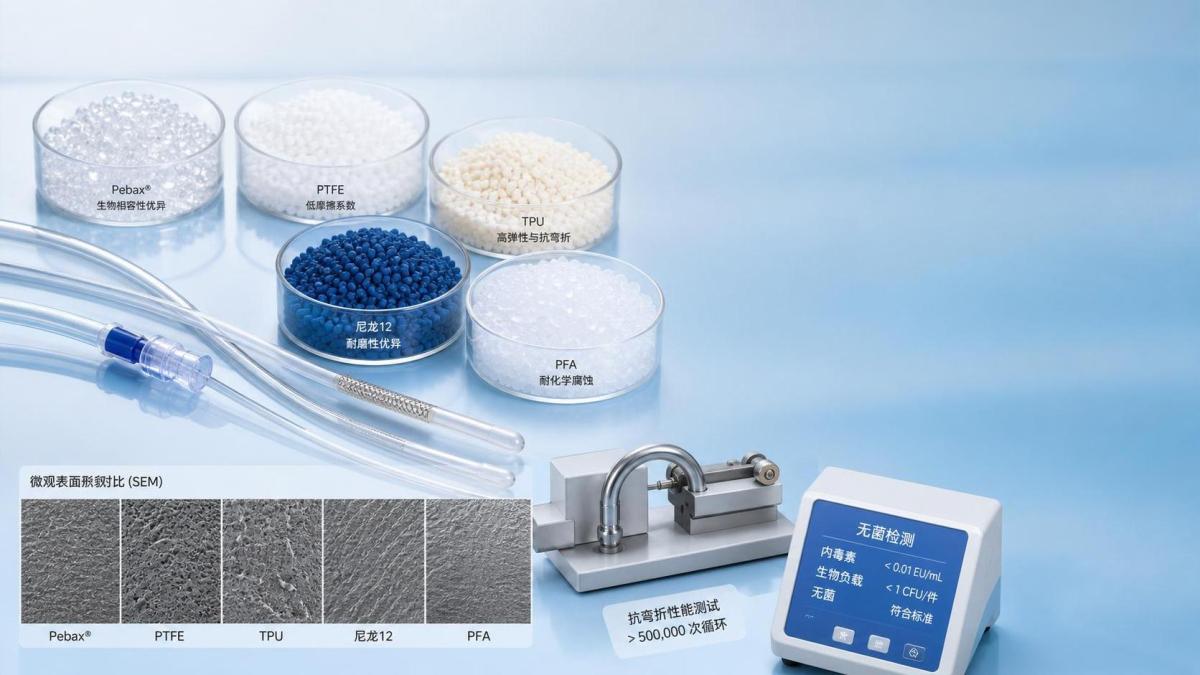
In catheter material selection vascular decisions, small material shifts can trigger large downstream problems.
A tube that feels acceptable in bench testing may still fail under blood contact, bending stress, or sterilization exposure.
That gap matters because vascular access devices operate in a narrow safety window.
Material choice affects insertion force, dwell stability, thrombus formation, extractables, and complaint trends.
It also shapes audit readiness, especially when design claims, supplier files, and biological evidence do not align.
For teams managing vascular access quality, the real question is not which polymer sounds advanced.
The real question is which material system can hold performance, safety, and compliance together over the product lifecycle.
Why Catheter Material Selection Vascular Risk Starts Early
Most vascular failures do not begin at the bedside.
They begin when material assumptions are copied from older products without checking new indications, dwell times, or insertion routes.
A peripheral catheter, a central venous catheter, and a neurovascular microcatheter do not share the same risk profile.
Yet catheter material selection vascular reviews often start with generic polymer categories such as PU, silicone, nylon, or Pebax.
That is too broad for reliable control.
In practice, performance is driven by the full material stack.
- Base polymer chemistry
- Radiopaque fillers and loading levels
- Plasticizers, stabilizers, and colorants
- Lubricious or antithrombotic coatings
- Bonding agents and reinforcement layers
- Sterilization compatibility
When one layer changes, the whole vascular access behavior can shift.
That is why early material mapping should be tied to use conditions, not supplier brochures.
The Main Material Risks Behind Vascular Access Complaints
From recent complaint patterns, four risk groups appear again and again.
1. Biocompatibility Drift
A material may pass historical screening yet become unsafe after formulation, coating, or sterilization changes.
Cytotoxicity, hemolysis, sensitization, and irritation risks can rise when residuals or degradation products are overlooked.
For long-dwell vascular access devices, the toxicological story must cover realistic contact duration and blood pathway exposure.
2. Kink and Collapse Under Use
Softness helps navigation, but too much softness can produce lumen collapse, flow loss, or permanent deformation.
This becomes critical in tortuous anatomy, sharp fixation angles, and repeated patient movement.
A good catheter material selection vascular process must test flexibility against real use geometry, not simple straight-line handling.
3. Thrombus and Surface Interaction Risk
Blood-compatible performance depends heavily on surface energy, roughness, and coating integrity.
A smooth material on paper may still develop platelet adhesion after processing damage or storage aging.
This is where vascular material selection becomes a patient safety decision, not just a design preference.
4. Chemical and Regulatory Mismatch
Some suppliers provide strong marketing sheets but weak traceability for additives, change control, and extractables data.
That creates trouble during ISO 10993 reviews, design history audits, and customer qualification checks.
In other words, poor documentation can turn an acceptable polymer into an unacceptable regulated product.
How to Evaluate Catheter Material Selection Vascular Performance
A practical review should connect material properties to failure modes.
That keeps decisions evidence-based and easier to defend.
This framework helps teams compare options without getting trapped by one attractive feature.
A low-friction catheter is not automatically a low-risk vascular access product.
The better signal is balanced performance across biological, mechanical, and compliance dimensions.
Material-by-Material Tradeoffs in Vascular Access
No single polymer solves every vascular access need.
What matters is understanding where each option becomes risky.
Polyurethane
PU is widely used because it balances strength and flexibility well.
Still, hydrolytic stability, additive migration, and stress cracking deserve close review.
Silicone
Silicone offers softness and long-term comfort.
But lower tear strength and handling challenges can affect insertion control and secure connections.
Nylon and Related Polyamides
These materials support pushability and dimensional precision.
However, moisture sensitivity and stiffness can create comfort or kink tradeoffs in vascular pathways.
Pebax and Multilayer Blends
These systems allow tuned durometer transitions for complex catheter material selection vascular needs.
The risk is process complexity.
Layer adhesion, filler dispersion, and lot variation can quietly undermine consistency.
What Quality Teams Should Ask Before Approving a Material
Approval meetings move faster when the questions are precise.
These checks usually expose weak catheter material selection vascular logic early.
- Does the biological evaluation reflect the final sterilized device, not only the raw resin?
- Have coating wear, particulate release, and aging effects been measured under simulated use?
- Are supplier change notifications contractually defined and realistically enforceable?
- Do test methods match the actual vascular access route and dwell condition?
- Can the technical file explain why this material is safer than nearby alternatives?
If the answer to several of these is unclear, the risk is already visible.
At that point, more samples alone will not fix the decision quality.
A More Defensible Approach to Catheter Material Selection Vascular Work
A stronger process begins with intended use, then works backward into material evidence.
That sounds simple, but it changes how teams prioritize data.
Instead of asking whether a polymer is commonly used, ask whether it remains stable and safe in this vascular access scenario.
Then align supplier qualification, verification plans, complaint trending, and regulatory rationale around that answer.
This is where IMCS-style market and regulatory intelligence becomes useful.
It helps connect material science, processing controls, and Class III evidence expectations before issues reach the field.
In the end, better catheter material selection vascular decisions are rarely about chasing the newest material.
They come from disciplined risk framing, realistic testing, and complete documentation.
That is the most practical way to reduce adverse events, protect product quality, and stay ready for scrutiny.
Get weekly intelligence in your inbox.
No noise. No sponsored content. Pure intelligence.
News Recommendations
 Sep 26, 2026How to verify FDA compliance for medical device materialsHow to verify FDA compliance for medical device materials
 Sep 25, 2026When does a porous 3D-printed cranial implant improve fixation?When does a porous 3D-printed cranial implant improve fixation?
 Sep 24, 2026When are bovine pericardial valves suitable for transcatheter aortic valve replacement?When are bovine pericardial valves suitable for transcatheter aortic valve replacement?
 Sep 23, 2026How to verify the sterility assurance of surgical devicesHow to verify the sterility assurance of surgical devices
 Sep 22, 2026How to assess a spinal implants manufacturer’s quality systemHow to assess a spinal implants manufacturer’s quality system
 Sep 21, 2026How to assess an osseointegration technology manufacturer’s quality systemHow to assess an osseointegration technology manufacturer’s quality system
 Sep 20, 2026Medical material science trends reshaping biocompatibility testingMedical material science trends reshaping biocompatibility testing
 Sep 19, 2026What North American regulators expect in implant clinical evaluationsWhat North American regulators expect in implant clinical evaluations
 Sep 18, 2026When should plate and screw systems be selected for fracture fixation?When should plate and screw systems be selected for fracture fixation?
 Sep 17, 2026How a medical device sourcing strategy can reduce total acquisition costHow a medical device sourcing strategy can reduce total acquisition cost
 Sep 16, 2026When are silver foam burn care dressings appropriate for exuding burns?When are silver foam burn care dressings appropriate for exuding burns?
 Sep 15, 2026What drives medical device category pricing in value-based purchasing?What drives medical device category pricing in value-based purchasing?
 Sep 14, 2026High value consumables insights for evaluating total cost of careHigh value consumables insights for evaluating total cost of care
 Sep 13, 2026What a medical device market insights platform reveals about market accessWhat a medical device market insights platform reveals about market access
 Sep 12, 2026When are collagen-based tissue healing materials suitable for wound care?When are collagen-based tissue healing materials suitable for wound care?
 Sep 11, 2026How catheter material selection affects total cost of ownershipHow catheter material selection affects total cost of ownership
 Sep 10, 2026What FDA clearance means for medical grade PEEK implantsWhat FDA clearance means for medical grade PEEK implants
 Sep 09, 2026When do hydrogel wound healing technologies suit dry wounds?When do hydrogel wound healing technologies suit dry wounds?
 Sep 07, 2026How to assess medical consumables for surgical useHow to assess medical consumables for surgical use
 Sep 07, 2026How to verify CE MDR compliance for single-use medical consumablesHow to verify CE MDR compliance for single-use medical consumables
 Sep 05, 2026How to evaluate an antithrombotic catheter factory for qualityHow to evaluate an antithrombotic catheter factory for quality
 Sep 04, 2026When do minimally invasive surgical staplers improve GI access?When do minimally invasive surgical staplers improve GI access?
 Sep 03, 2026When are foam moist wound healing dressings appropriate for exuding wounds?When are foam moist wound healing dressings appropriate for exuding wounds?
 Sep 02, 2026How implant pricing affects access to advanced medical careHow implant pricing affects access to advanced medical care
 Sep 01, 2026What is driving price pressure in the North American medical consumables market?What is driving price pressure in the North American medical consumables market?
 Aug 31, 2026Comparing medical devices in Southeast Asia when market access differsComparing medical devices in Southeast Asia when market access differs
 Aug 30, 2026When are 3D printed PEEK implants suitable for spinal reconstruction?When are 3D printed PEEK implants suitable for spinal reconstruction?